Home›Hazard classes
Reference · Classification
GHS hazard classes and categories
There are 33 hazard classes under GHS — 17 physical, 13 health and 3 environmental — plus 4 that exist only in EU CLP. Inside them sit 112 categories recognised by EU CLP, each carrying a fixed set of label elements. Every one of them is below, with its pictogram, signal word, hazard statement and the official criteria.
01 · How to read this list
Three things a plain class list will not tell you
Class vs category
The class names the hazard, the category grades it
“Skin corrosion/irritation” is a class. Categories 1A, 1B, 1C and 2 sit inside it, running from severe corrosion to mild irritation. The class tells you which hazard you are dealing with; the category decides what reaches the label, because two categories of the same class can carry different pictograms and different signal words.
Not every category labels
3 categories carry no label elements at all
These sit inside CLP yet carry no pictogram, no signal word and no hazard statement. That is the regulation working as intended: the substance is still classified into the class, but the hazard was judged not to warrant label communication. An empty label row for them is the correct result, not a data gap.
GHS ≠ CLP
9 UN GHS categories the EU never adopted
GHS is a set of building blocks, and a jurisdiction may take a class while leaving out some of its categories. A substance meeting only these criteria is not classified for that hazard in Europe — which is exactly why the same product can ship with different labels in different regions.
02 · The list
All 33 GHS hazard classes and 4 EU-only classes, grouped as the regulation groups them
Order follows the regulation, not the alphabet. Each row links its hazard statement and precautionary statements to their own pages, so a label can be assembled by following the links.
Physical hazards
17 classesPhysical hazard classes describe how a substance behaves on its own — whether it burns, explodes, reacts with water, releases oxygen or attacks metal. Classification rests on measured physical tests rather than on toxicological studies, which is why the criteria read as thresholds and test outcomes.
Explosives
GHS 2.1| Category | Pictogram | Signal word | Hazard statement | Precautionary | Criteria |
|---|---|---|---|---|---|
| 1.1 | 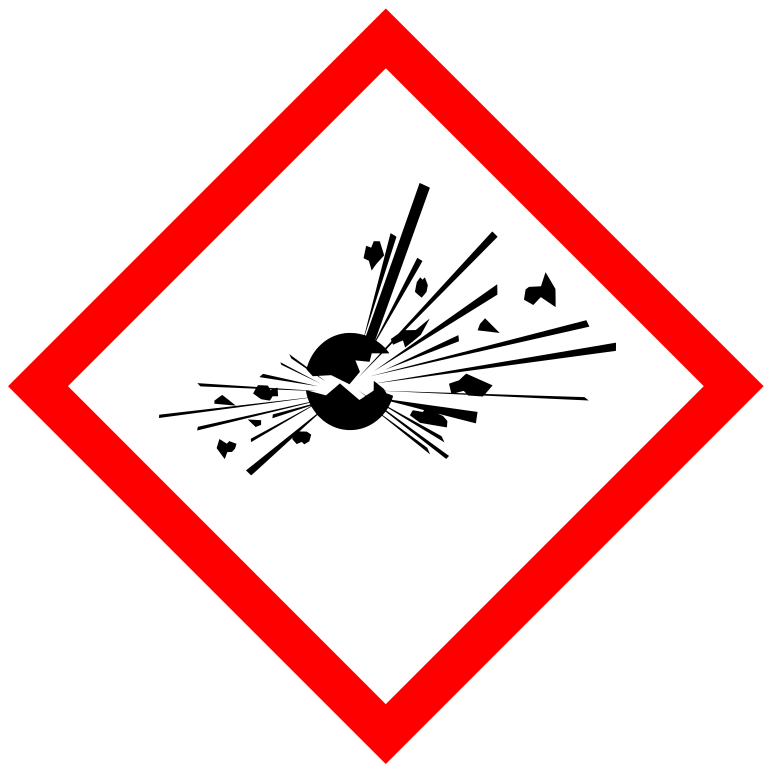 GHS01 GHS01 | Danger | H201 | CriteriaFor explosives of Divisions 1.1 to 1.6, the following are the core set of tests that need to be performed: Explosibility: according to UN Test Series 2 (section 12 of the UN RTDG, Manual of Tests and Criteria). Intentional explosives (1) shall not be subject to UN Test Series 2. Sensitiveness: according to UN Test Series 3 (section 13 of the UN RTDG, Manual of Tests and Criteria). Thermal stability: according to UN Test 3(c) (sub-section 13.6.1 of the UN RTDG, Manual of Tests and Criteria). Further tests are necessary to allocate the correct Division. — Explosives (section 2.1) (1) This comprises substances, mixtures and articles which are manufactured with a view to producing a practical, explosive or pyrotechnic effect. | |
| 1.2 | GHS01 | Danger | H202 | CriteriaFor explosives of Divisions 1.1 to 1.6, the following are the core set of tests that need to be performed: Explosibility: according to UN Test Series 2 (section 12 of the UN RTDG, Manual of Tests and Criteria). Intentional explosives (1) shall not be subject to UN Test Series 2. Sensitiveness: according to UN Test Series 3 (section 13 of the UN RTDG, Manual of Tests and Criteria). Thermal stability: according to UN Test 3(c) (sub-section 13.6.1 of the UN RTDG, Manual of Tests and Criteria). Further tests are necessary to allocate the correct Division. — Explosives (section 2.1) (1) This comprises substances, mixtures and articles which are manufactured with a view to producing a practical, explosive or pyrotechnic effect. | |
| 1.3 | GHS01 | Danger | H203 | CriteriaFor explosives of Divisions 1.1 to 1.6, the following are the core set of tests that need to be performed: Explosibility: according to UN Test Series 2 (section 12 of the UN RTDG, Manual of Tests and Criteria). Intentional explosives (1) shall not be subject to UN Test Series 2. Sensitiveness: according to UN Test Series 3 (section 13 of the UN RTDG, Manual of Tests and Criteria). Thermal stability: according to UN Test 3(c) (sub-section 13.6.1 of the UN RTDG, Manual of Tests and Criteria). Further tests are necessary to allocate the correct Division. — Explosives (section 2.1) (1) This comprises substances, mixtures and articles which are manufactured with a view to producing a practical, explosive or pyrotechnic effect. | |
| 1.4 | GHS01 | Warning | H204 | CriteriaFor explosives of Divisions 1.1 to 1.6, the following are the core set of tests that need to be performed: Explosibility: according to UN Test Series 2 (section 12 of the UN RTDG, Manual of Tests and Criteria). Intentional explosives (1) shall not be subject to UN Test Series 2. Sensitiveness: according to UN Test Series 3 (section 13 of the UN RTDG, Manual of Tests and Criteria). Thermal stability: according to UN Test 3(c) (sub-section 13.6.1 of the UN RTDG, Manual of Tests and Criteria). Further tests are necessary to allocate the correct Division. — Explosives (section 2.1) (1) This comprises substances, mixtures and articles which are manufactured with a view to producing a practical, explosive or pyrotechnic effect. | |
| 1.5 | none | Danger | H205 | CriteriaFor explosives of Divisions 1.1 to 1.6, the following are the core set of tests that need to be performed: Explosibility: according to UN Test Series 2 (section 12 of the UN RTDG, Manual of Tests and Criteria). Intentional explosives (1) shall not be subject to UN Test Series 2. Sensitiveness: according to UN Test Series 3 (section 13 of the UN RTDG, Manual of Tests and Criteria). Thermal stability: according to UN Test 3(c) (sub-section 13.6.1 of the UN RTDG, Manual of Tests and Criteria). Further tests are necessary to allocate the correct Division. — Explosives (section 2.1) (1) This comprises substances, mixtures and articles which are manufactured with a view to producing a practical, explosive or pyrotechnic effect. | |
| 1.6 | none | none | none | none | CriteriaFor explosives of Divisions 1.1 to 1.6, the following are the core set of tests that need to be performed: Explosibility: according to UN Test Series 2 (section 12 of the UN RTDG, Manual of Tests and Criteria). Intentional explosives (1) shall not be subject to UN Test Series 2. Sensitiveness: according to UN Test Series 3 (section 13 of the UN RTDG, Manual of Tests and Criteria). Thermal stability: according to UN Test 3(c) (sub-section 13.6.1 of the UN RTDG, Manual of Tests and Criteria). Further tests are necessary to allocate the correct Division. (1) This comprises substances, mixtures and articles which are manufactured with a view to producing a practical, explosive or pyrotechnic effect. |
| Unstable explosive | GHS01 | Danger | H200 | CriteriaFor explosives of Divisions 1.1 to 1.6, the following are the core set of tests that need to be performed: Explosibility: according to UN Test Series 2 (section 12 of the UN RTDG, Manual of Tests and Criteria). Intentional explosives (1) shall not be subject to UN Test Series 2. Sensitiveness: according to UN Test Series 3 (section 13 of the UN RTDG, Manual of Tests and Criteria). Thermal stability: according to UN Test 3(c) (sub-section 13.6.1 of the UN RTDG, Manual of Tests and Criteria). Further tests are necessary to allocate the correct Division. — Explosives (section 2.1) (1) This comprises substances, mixtures and articles which are manufactured with a view to producing a practical, explosive or pyrotechnic effect. |
Flammable gases
GHS 2.2| Category | Pictogram | Signal word | Hazard statement | Precautionary | Criteria |
|---|---|---|---|---|---|
| 1A | 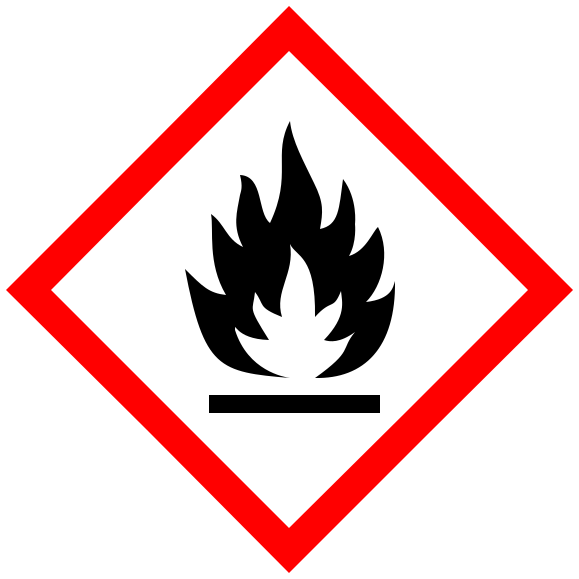 GHS02 GHS02 | Danger | H220 | CriteriaGases, which at 20 °C and a standard pressure of 101,3 kPa are: (a) ignitable when in a mixture of 13 % or less by volume in air; or (b) have a flammable range with air of at least 12 percentage points regardless of the lower flammability limit unless data show they meet the criteria for Category 1B — Flammable gases (section 2.2) | |
| 1B | GHS02 | Danger | H221 | CriteriaGases which meet the flammability criteria for Category 1A, but which are not pyrophoric, nor chemically unstable, and which have at least either: (a) a lower flammability limit of more than 6 % by volume in air; or (b) a fundamental burning velocity of less than 10 cm/s; — Flammable gases (section 2.2) | |
| 2 | none | Warning | H221 | CriteriaGases, other than those of Category 1A or 1B, which, at 20 °C and a standard pressure of 101,3 kPa, have a flammable range while mixed in air. — Flammable gases (section 2.2) | |
| Chemically unstable A | GHS02 | Danger | H230 | 1 P-codes | CriteriaFlammable gases which are chemically unstable at 20 °C and a standard pressure of 101,3 kPa — Flammable gases (section 2.2) |
| Chemically unstable B | GHS02 | Danger | H231 | 1 P-codes | CriteriaFlammable gases which are chemically unstable at a temperature greater than 20 °C and/or a pressure greater than 101,3 kPa — Flammable gases (section 2.2) |
| Pyrophoric | GHS02 | Danger | H232 | CriteriaFlammable gases that ignite spontaneously in air at a temperature of 54 °C or below — Flammable gases (section 2.2) |
Aerosols
GHS 2.3| Category | Pictogram | Signal word | Hazard statement | Precautionary | Criteria |
|---|---|---|---|---|---|
| 1 | GHS02 | Danger | H222 | CriteriaAerosols shall be classified in one of the three categories of this hazard class, depending on their flammable properties and their heat of combustion. They shall be considered for classification in Category 1 or 2 if they contain more than 1 % components (by mass) which are classified as flammable according to the following criteria set out in this Part: — Flammable gases (see Section 2.2); — Liquids with a flash point ≤ 93 °C, which includes Flammable Liquids according to Section 2.6; — Flammable solids (see Section 2.7); or if their heat of combustion is at least 20 kJ/g. NOTE 1: Flammable components do not cover pyrophoric, self- heating or water-reactive substances and mixtures because such components are never used as aerosol contents. NOTE 2: Aerosols do not fall additionally within the scope of Sections 2.2 (flammable gases), 2.5 (gases under pressure), 2.6 (flammable liquids) and 2.7 (flammable solids). Depending on their contents, aerosols may however fall within the scope of other hazard classes, including their labelling elements. / An aerosol shall be classified in one of the three categories for this Class on the basis of its components, of its chemical heat of combustion and, if applicable, of the results of the foam test (for foam aerosols) and of the ignition distance test and enclosed space test (for spray aerosols) in accordance with Figures 2.3.1(a) to 2.3.1 (c) of this Annex and subsections 31.4, 31.5 and 31.6 of Part III of the UN RTDG, Manual of Tests and Criteria. Aerosols which do not meet the criteria for inclusion in Category 1 or Category 2 shall be classified in Category 3. Note: Aerosols containing more than 1 % flammable components or with a heat of combustion of at least 20 kJ/g, which are not submitted to the flammability classification procedures in this section shall be classified as aerosols, Category 1. Figure 2.3.1 (a) For aerosols Figure 2.3.1 (b) Spray aerosols Figure 2.3.1 (c) Foam aerosols 2.3.3. Hazard Communication Label elements shall be used for substances or mixtures meeting the criteria for classification in this hazard class in accordance with — Aerosols (section 2.3) | |
| 2 | GHS02 | Warning | H223 | CriteriaAerosols shall be classified in one of the three categories of this hazard class, depending on their flammable properties and their heat of combustion. They shall be considered for classification in Category 1 or 2 if they contain more than 1 % components (by mass) which are classified as flammable according to the following criteria set out in this Part: — Flammable gases (see Section 2.2); — Liquids with a flash point ≤ 93 °C, which includes Flammable Liquids according to Section 2.6; — Flammable solids (see Section 2.7); or if their heat of combustion is at least 20 kJ/g. NOTE 1: Flammable components do not cover pyrophoric, self- heating or water-reactive substances and mixtures because such components are never used as aerosol contents. NOTE 2: Aerosols do not fall additionally within the scope of Sections 2.2 (flammable gases), 2.5 (gases under pressure), 2.6 (flammable liquids) and 2.7 (flammable solids). Depending on their contents, aerosols may however fall within the scope of other hazard classes, including their labelling elements. / An aerosol shall be classified in one of the three categories for this Class on the basis of its components, of its chemical heat of combustion and, if applicable, of the results of the foam test (for foam aerosols) and of the ignition distance test and enclosed space test (for spray aerosols) in accordance with Figures 2.3.1(a) to 2.3.1 (c) of this Annex and subsections 31.4, 31.5 and 31.6 of Part III of the UN RTDG, Manual of Tests and Criteria. Aerosols which do not meet the criteria for inclusion in Category 1 or Category 2 shall be classified in Category 3. Note: Aerosols containing more than 1 % flammable components or with a heat of combustion of at least 20 kJ/g, which are not submitted to the flammability classification procedures in this section shall be classified as aerosols, Category 1. Figure 2.3.1 (a) For aerosols Figure 2.3.1 (b) Spray aerosols Figure 2.3.1 (c) Foam aerosols 2.3.3. Hazard Communication Label elements shall be used for substances or mixtures meeting the criteria for classification in this hazard class in accordance with — Aerosols (section 2.3) | |
| 3 | none | Warning | H229 | CriteriaAerosols shall be classified in one of the three categories of this hazard class, depending on their flammable properties and their heat of combustion. They shall be considered for classification in Category 1 or 2 if they contain more than 1 % components (by mass) which are classified as flammable according to the following criteria set out in this Part: — Flammable gases (see Section 2.2); — Liquids with a flash point ≤ 93 °C, which includes Flammable Liquids according to Section 2.6; — Flammable solids (see Section 2.7); or if their heat of combustion is at least 20 kJ/g. NOTE 1: Flammable components do not cover pyrophoric, self- heating or water-reactive substances and mixtures because such components are never used as aerosol contents. NOTE 2: Aerosols do not fall additionally within the scope of Sections 2.2 (flammable gases), 2.5 (gases under pressure), 2.6 (flammable liquids) and 2.7 (flammable solids). Depending on their contents, aerosols may however fall within the scope of other hazard classes, including their labelling elements. / An aerosol shall be classified in one of the three categories for this Class on the basis of its components, of its chemical heat of combustion and, if applicable, of the results of the foam test (for foam aerosols) and of the ignition distance test and enclosed space test (for spray aerosols) in accordance with Figures 2.3.1(a) to 2.3.1 (c) of this Annex and subsections 31.4, 31.5 and 31.6 of Part III of the UN RTDG, Manual of Tests and Criteria. Aerosols which do not meet the criteria for inclusion in Category 1 or Category 2 shall be classified in Category 3. Note: Aerosols containing more than 1 % flammable components or with a heat of combustion of at least 20 kJ/g, which are not submitted to the flammability classification procedures in this section shall be classified as aerosols, Category 1. Figure 2.3.1 (a) For aerosols Figure 2.3.1 (b) Spray aerosols Figure 2.3.1 (c) Foam aerosols 2.3.3. Hazard Communication Label elements shall be used for substances or mixtures meeting the criteria for classification in this hazard class in accordance with — Aerosols (section 2.3) |
Oxidising gases
GHS 2.4Gases under pressure
GHS 2.5| Category | Pictogram | Signal word | Hazard statement | Precautionary | Criteria |
|---|---|---|---|---|---|
| Compressed gas |  GHS04 GHS04 | Warning | H280 | CriteriaA gas which when packaged under pressure is entirely gaseous at – 50 °C; including all gases with a critical temperature ≤ – 50 °C. — Gases under pressure (section 2.5) | |
| Dissolved gas | GHS04 | Warning | H280 | CriteriaA gas which when packaged under pressure is dissolved in a liquid phase solvent. — Gases under pressure (section 2.5) | |
| Liquefied gas | GHS04 | Warning | H280 | CriteriaA gas which, when packaged under pressure, is partially liquid at temperatures above – 50 °C. A distinction is made between: (i) high pressure liquefied gas: a gas with a critical temperature between – 50 °C and + 65 °C; and (ii) low pressure liquefied gas: a gas with a critical temperature above + 65 °C. — Gases under pressure (section 2.5) | |
| Refrigerated liquefied gas | GHS04 | Warning | H281 | CriteriaA gas which when packaged is made partially liquid because of its low temperature. — Gases under pressure (section 2.5) |
Flammable liquids
GHS 2.6| Category | Pictogram | Signal word | Hazard statement | Precautionary | Criteria |
|---|---|---|---|---|---|
| 1 | GHS02 | Danger | H224 | CriteriaFlash point < 23 °C and initial boiling point ≤ 35 °C — Flammable liquids (section 2.6) | |
| 2 | GHS02 | Danger | H225 | CriteriaFlash point < 23 °C and initial boiling point > 35 °C — Flammable liquids (section 2.6) | |
| 3 | GHS02 | Warning | H226 | CriteriaFlash point ≥ 23 °C and ≤ 60 °C (1) — Flammable liquids (section 2.6) (1) For the purpose of this Regulation gas oils, diesel and light heating oils having a flash point between ≥ 55 °C and ≤ 75 °C may be regarded as Category 3. |
Flammable solids
GHS 2.7| Category | Pictogram | Signal word | Hazard statement | Precautionary | Criteria |
|---|---|---|---|---|---|
| 1 | GHS02 | Danger | H228 | CriteriaBurning rate test Substances and mixtures other than metal powders: (a) wetted zone does not stop fire and (b) burning time < 45 seconds or burning rate > 2,2 mm/s Metal powders burning time ≤ 5 minutes — Flammable solids (section 2.7) | |
| 2 | GHS02 | Warning | H228 | CriteriaBurning rate test Substances and mixtures other than metal powders: (a) wetted zone stops the fire for at least 4 minutes and (b) burning time < 45 seconds or burning rate > 2,2 mm/s Metal powders burning time > 5 minutes and ≤ 10 minutes — Flammable solids (section 2.7) |
Self-reactive substances and mixtures
GHS 2.8| Category | Pictogram | Signal word | Hazard statement | Precautionary | Criteria |
|---|---|---|---|---|---|
| Type A | GHS01 | Danger | H240 | Criteriaany self-reactive substance or mixture which can detonate or deflagrate rapidly, as packaged, shall be defined as self-reactive substance TYPE A; — Self-reactive substances and mixtures (section 2.8) | |
| Type B | GHS02 | Danger | H241 | Criteriaany self-reactive substance or mixture possessing explosive properties and which, as packaged, neither detonates nor defla grates rapidly, but is liable to undergo a thermal explosion in that package shall be defined as self-reactive substance TYPE B; — Self-reactive substances and mixtures (section 2.8) | |
| Type B | GHS01 | Danger | H241 | Criteriaany self-reactive substance or mixture possessing explosive properties and which, as packaged, neither detonates nor defla grates rapidly, but is liable to undergo a thermal explosion in that package shall be defined as self-reactive substance TYPE B; — Self-reactive substances and mixtures (section 2.8) | |
| Type C and D | GHS02 | Danger | H242 | Criteriaany self-reactive substance or mixture possessing explosive properties when the substance or mixture as packaged cannot detonate or deflagrate rapidly or undergo a thermal explosion shall be defined as self-reactive substance TYPE C; — Self-reactive substances and mixtures (section 2.8) any self-reactive substance or mixture which in laboratory testing: (i) detonates partially, does not deflagrate rapidly and shows no violent effect when heated under confinement; or (ii) does not detonate at all, deflagrates slowly and shows no violent effect when heated under confinement; or (iii) does not detonate or deflagrate at all and shows a medium effect when heated under confinement; shall be defined as self-reactive substance TYPE D; — Self-reactive substances and mixtures (section 2.8) | |
| Type E and F | GHS02 | Warning | H242 | Criteriaany self-reactive substance or mixture which, in laboratory testing, neither detonates nor deflagrates at all and shows low or no effect when heated under confinement shall be defined as self-reactive substance TYPE E; — Self-reactive substances and mixtures (section 2.8) any self-reactive substance or mixture which, in laboratory testing, neither detonates in the cavitated state nor deflagrates at all and shows only a low or no effect when heated under confinement as well as low or no explosive power shall be defined as self-reactive substance TYPE F; — Self-reactive substances and mixtures (section 2.8) | |
| Type G | none | none | none | none | Criteriaany self-reactive substance or mixture which, in laboratory testing, neither detonates in the cavitated state nor deflagrates at all and shows no effect when heated under confinement nor any explosive power, provided that it is thermally stable (SADT is 60 °C to 75 °C for a 50 kg package), and, for liquid mixtures, a diluent having a boiling point not less than 150 °C is used for desensitisation shall be defined as self- reactive substance TYPE G. If the mixture is not thermally stable or a diluent having a boiling point less than 150 °C is used for desensitisation, the mixture shall be defined as self- reactive substance TYPE F. |
Pyrophoric liquids
GHS 2.9Pyrophoric solids
GHS 2.10Self-heating substances and mixtures
GHS 2.11| Category | Pictogram | Signal word | Hazard statement | Precautionary | Criteria |
|---|---|---|---|---|---|
| 1 | GHS02 | Danger | H251 | CriteriaA positive result is obtained in a test using a 25 mm sample cube at 140 °C — Self-heating substances and mixtures (section 2.11) | |
| 2 | GHS02 | Warning | H252 | Criteria(a) a positive result is obtained in a test using a 100 mm sample cube at 140 °C and a negative result is obtained in a test using a 25 mm cube sample at 140 °C and the substance or mixture is to be packed in packages with a volume of more than 3 m3; or (b) a positive result is obtained in a test using a 100 mm sample cube at 140 °C and a negative result is obtained in a test using a 25 mm cube sample at 140 °C, a positive result is obtained in a test using a 100 mm cube sample at 120 °C and the substance or mixture is to be packed in packages with a volume of more than 450 litres; or (c) a positive result is obtained in a test using a 100 mm sample cube at 140 °C and a negative result is obtained in a test using a 25 mm cube sample at 140 °C and a positive result is obtained in a test using a 100 mm cube sample at 100 °C. — Self-heating substances and mixtures (section 2.11) |
In contact with water emits flammable gases
GHS 2.12| Category | Pictogram | Signal word | Hazard statement | Precautionary | Criteria |
|---|---|---|---|---|---|
| 1 | GHS02 | Danger | H260 | CriteriaAny substance or mixture which reacts vigorously with water at ambient temperatures and demonstrates generally a tendency for the gas produced to ignite spontaneously, or which reacts readily with water at ambient temperatures such that the rate of evolution of flammable gas is equal to or greater than 10 litres per kilogram of substance over any one minute. — Substances and mixtures which, in contact with water, emit flammable gases (section 2.12) | |
| 2 | GHS02 | Danger | H261 | CriteriaAny substance or mixture which reacts readily with water at ambient temperatures such that the maximum rate of evolution of flammable gas is equal to or greater than 20 litres per kilogram of substance per hour, and which does not meet the criteria for Category 1. — Substances and mixtures which, in contact with water, emit flammable gases (section 2.12) | |
| 3 | GHS02 | Warning | H261 | CriteriaAny substance or mixture which reacts slowly with water at ambient temperatures such that the maximum rate of evolution of flammable gas is greater than 1 litre per kilogram of substance per hour, and which does not meet the criteria for Categories 1 and 2. — Substances and mixtures which, in contact with water, emit flammable gases (section 2.12) |
Oxidising liquids
GHS 2.13| Category | Pictogram | Signal word | Hazard statement | Precautionary | Criteria |
|---|---|---|---|---|---|
| 1 | 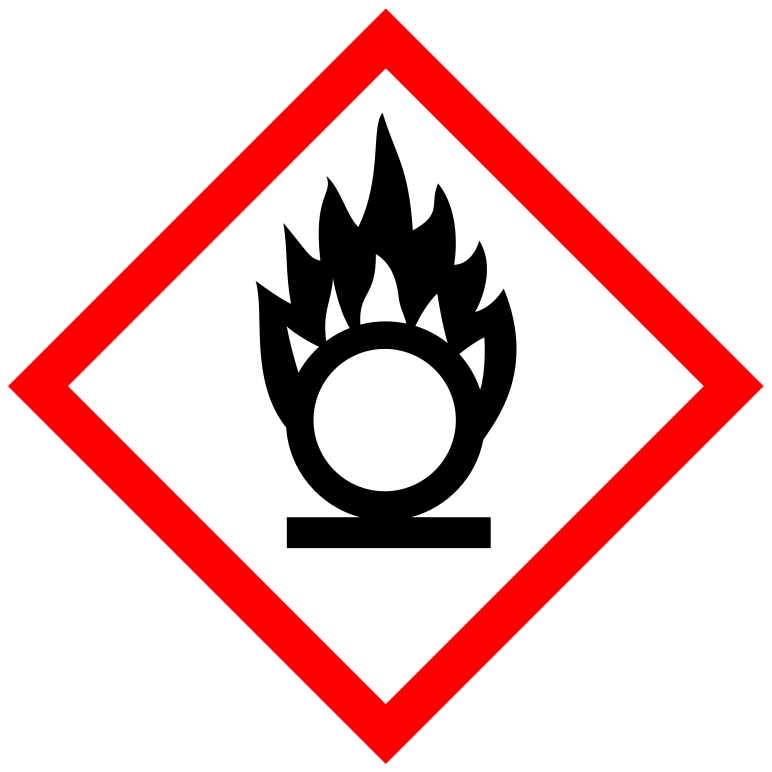 GHS03 GHS03 | Danger | H271 | CriteriaAny substance or mixture which, in the 1:1 mixture, by mass, of substance (or mixture) and cellulose tested, spontaneously ignites; or the mean pressure rise time of a 1:1 mixture, by mass, of substance (or mixture) and cellulose is less than that of a 1:1 mixture, by mass, of 50 % perchloric acid and cellulose. — Oxidising liquids (section 2.13) | |
| 2 | GHS03 | Danger | H272 | CriteriaAny substance or mixture which, in the 1:1 mixture, by mass, of substance (or mixture) and cellulose tested, exhibits a mean pressure rise time less than or equal to the mean pressure rise time of a 1:1 mixture, by mass, of 40 % aqueous sodium chlorate solution and cellulose; and the criteria for Category 1 are not met. — Oxidising liquids (section 2.13) | |
| 3 | GHS03 | Warning | H272 | CriteriaAny substance or mixture which, in the 1:1 mixture, by mass, of substance (or mixture) and cellulose tested, exhibits a mean pressure rise time less than or equal to the mean pressure rise time of a 1:1 mixture, by mass, of 65 % aqueous nitric acid and cellulose; and the criteria for Category 1 and 2 are not met. — Oxidising liquids (section 2.13) |
Oxidising solids
GHS 2.14| Category | Pictogram | Signal word | Hazard statement | Precautionary | Criteria |
|---|---|---|---|---|---|
| 1 | GHS03 | Danger | H271 | CriteriaCriteria using test O.1: Any substance or mixture which, in the 4:1 or 1:1 sample-to-cellulose ratio (by mass) tested, exhibits a mean burning time less than the mean burning time of a 3:2 mixture, (by mass), of potassium bromate and cellulose. | Criteria using test O.3: Any substance or mixture which, in the 4:1 or 1:1 sample-to-cellulose ratio (by mass) tested, exhibits a mean burning rate greater than the mean burning rate of a 3:1 mixture (by mass) of calcium peroxide and cellulose. — Oxidising solids (section 2.14) | |
| 2 | GHS03 | Danger | H272 | CriteriaCriteria using test O.1: Any substance or mixture which, in the 4:1 or 1:1 sample-to-cellulose ratio (by mass) tested, exhibits a mean burning time equal to or less than the mean burning time of a 2:3 mixture (by mass) of potassium bromate and cellulose and the criteria for Category 1 are not met. | Criteria using test O.3: Any substance or mixture which, in the 4:1 or 1:1 sample-to-cellulose ratio (by mass) tested, exhibits a mean burning rate equal to or greater than the mean burning rate of a 1:1 mixture (by mass) of calcium peroxide and cellulose and the criteria for Category 1 are not met. — Oxidising solids (section 2.14) | |
| 3 | GHS03 | Warning | H272 | CriteriaCriteria using test O.1: Any substance or mixture which, in the 4:1 or 1:1 sample-to-cellulose ratio (by mass) tested, exhibits a mean burning time equal to or less than the mean burning time of a 3:7 mixture (by mass) of potassium bromate and cellulose and the criteria for Categories 1 and 2 are not met. | Criteria using test O.3: Any substance or mixture which, in the 4:1 or 1:1 sample-to-cellulose ratio (by mass) tested, exhibits a mean burning rate equal to or greater than the mean burning rate of a 1:2 mixture (by mass) of calcium peroxide and cellulose and the criteria for Categories 1 and 2 are not met. — Oxidising solids (section 2.14) |
Organic peroxides
GHS 2.15| Category | Pictogram | Signal word | Hazard statement | Precautionary | Criteria |
|---|---|---|---|---|---|
| Type A | GHS01 | Danger | H240 | Criteriaany organic peroxide which, as packaged, can detonate or deflagrate rapidly shall be defined as organic peroxide TYPE A; — Organic peroxides (section 2.15) | |
| Type B | GHS02 | Danger | H241 | Criteriaany organic peroxide possessing explosive properties and which, as packaged, neither detonates nor deflagrates rapidly, but is liable to undergo a thermal explosion in that package shall be defined as organic peroxide TYPE B; — Organic peroxides (section 2.15) | |
| Type B | GHS01 | Danger | H241 | Criteriaany organic peroxide possessing explosive properties and which, as packaged, neither detonates nor deflagrates rapidly, but is liable to undergo a thermal explosion in that package shall be defined as organic peroxide TYPE B; — Organic peroxides (section 2.15) | |
| Type C and D | GHS02 | Danger | H242 | Criteriaany organic peroxide possessing explosive properties when the substance or mixture as packaged cannot detonate or deflagrate rapidly or undergo a thermal explosion shall be defined as organic peroxide TYPE C; — Organic peroxides (section 2.15) any organic peroxide which in laboratory testing: (i) detonates partially, does not deflagrate rapidly and shows no violent effect when heated under confinement; or (ii) does not detonate at all, deflagrates slowly and shows no violent effect when heated under confinement; or (iii) does not detonate or deflagrate at all and shows a medium effect when heated under confinement; shall be defined as organic peroxide TYPE D; — Organic peroxides (section 2.15) | |
| Type E and F | GHS02 | Warning | H242 | Criteriaany organic peroxide which, in laboratory testing, neither detonates nor deflagrates at all and shows low or no effect when heated under confinement shall be defined as organic peroxide TYPE E; — Organic peroxides (section 2.15) any organic peroxide which, in laboratory testing, neither detonates in the cavitated state nor deflagrates at all and shows only a low or no effect when heated under confinement as well as low or no explosive power shall be defined as organic peroxide TYPE F; — Organic peroxides (section 2.15) | |
| Type G | none | none | none | none | Criteriaany organic peroxide which, in laboratory testing, neither detonates in the cavitated state nor deflagrates at all and shows no effect when heated under confinement nor any explosive power, provided that it is thermally stable, i.e. the SADT is 60 °C or higher for a 50 kg package (1), and, for liquid mixtures, a diluent having a boiling point of not less than 150 °C is used for desensitisation, shall be defined as organic peroxide TYPE G. If the organic peroxide is not thermally stable or a diluent having a boiling point less than 150 °C is used for desensitisation, the organic peroxide shall be defined as organic peroxide TYPE F. |
Corrosive to metals
GHS 2.16Desensitised explosives
GHS 2.17| Category | Pictogram | Signal word | Hazard statement | Precautionary | Criteria |
|---|---|---|---|---|---|
| 1 | GHS02 | Danger | H206 | CriteriaDesensitised explosives with a corrected burning rate (AC) equal to or greater than 300 kg/min but not more than 1 200 kg/min — Desensitised explosives (section 2.17) | |
| 2 | GHS02 | Danger | H207 | CriteriaDesensitised explosives with a corrected burning rate (AC) equal to or greater than 140 kg/min but less than 300 kg/min — Desensitised explosives (section 2.17) | |
| 3 | GHS02 | Warning | H207 | CriteriaDesensitised explosives with a corrected burning rate (AC) equal to or greater than 60 kg/min but less than 140 kg/min — Desensitised explosives (section 2.17) | |
| 4 | GHS02 | Warning | H208 | CriteriaDesensitised explosives with a corrected burning rate (AC) less than 60 kg/min — Desensitised explosives (section 2.17) |
Health hazards
13 classesHealth hazard classes describe what a substance does to the human body, from a single exposure causing immediate harm to repeated exposure causing damage over years. Several split into sub-categories that differ only in the strength of the evidence behind them.
Acute toxicity - oral
GHS 3.1| Category | Pictogram | Signal word | Hazard statement | Precautionary | Criteria |
|---|---|---|---|---|---|
| 1 | 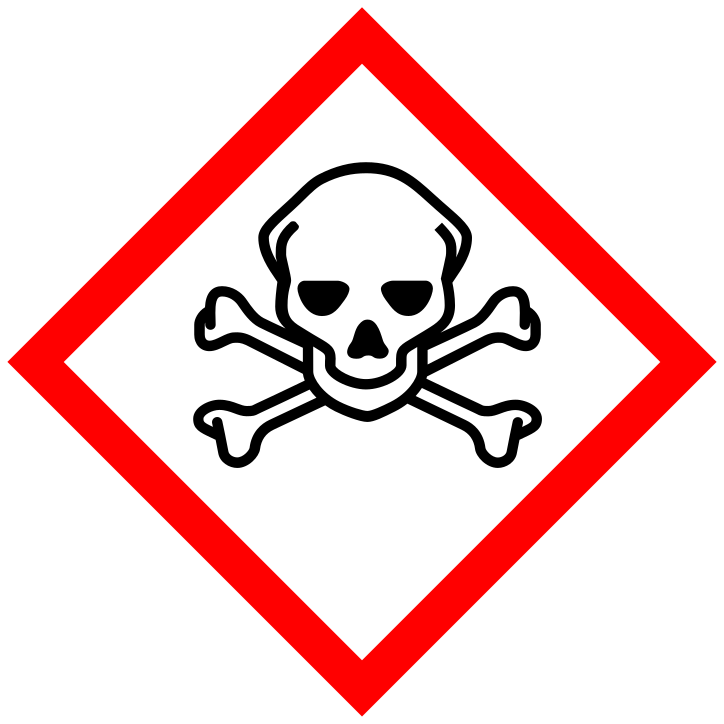 GHS06 GHS06 | Danger | H300 | CriteriaATE ≤ 5 mg/kg bodyweight — Acute toxicity — oral (section 3.1) (a) The acute toxicity estimate (ATE) for the classification of a substance is derived using the LD50/LC50 where available. (b) The acute toxicity estimate (ATE) for the classification of a substance in a mixture is derived using: — the LD50/LC50 where available, — the appropriate conversion value from Table 3.1.2 that relates to the results of a range test, or — the appropriate conversion value from Table 3.1.2 that relates to a classification category. | |
| 2 | GHS06 | Danger | H300 | Criteria5 < ATE ≤ 50 mg/kg bodyweight — Acute toxicity — oral (section 3.1) (a) The acute toxicity estimate (ATE) for the classification of a substance is derived using the LD50/LC50 where available. (b) The acute toxicity estimate (ATE) for the classification of a substance in a mixture is derived using: — the LD50/LC50 where available, — the appropriate conversion value from Table 3.1.2 that relates to the results of a range test, or — the appropriate conversion value from Table 3.1.2 that relates to a classification category. | |
| 3 | GHS06 | Danger | H301 | Criteria50 < ATE ≤ 300 mg/kg bodyweight — Acute toxicity — oral (section 3.1) (a) The acute toxicity estimate (ATE) for the classification of a substance is derived using the LD50/LC50 where available. (b) The acute toxicity estimate (ATE) for the classification of a substance in a mixture is derived using: — the LD50/LC50 where available, — the appropriate conversion value from Table 3.1.2 that relates to the results of a range test, or — the appropriate conversion value from Table 3.1.2 that relates to a classification category. | |
| 4 |  GHS07 GHS07 | Warning | H302 | Criteria300 < ATE ≤ 2 000 mg/kg bodyweight — Acute toxicity — oral (section 3.1) (a) The acute toxicity estimate (ATE) for the classification of a substance is derived using the LD50/LC50 where available. (b) The acute toxicity estimate (ATE) for the classification of a substance in a mixture is derived using: — the LD50/LC50 where available, — the appropriate conversion value from Table 3.1.2 that relates to the results of a range test, or — the appropriate conversion value from Table 3.1.2 that relates to a classification category. |
Acute toxicity - dermal
GHS 3.1| Category | Pictogram | Signal word | Hazard statement | Precautionary | Criteria |
|---|---|---|---|---|---|
| 1 | GHS06 | Danger | H310 | CriteriaATE ≤ 50 mg/kg bodyweight — Acute toxicity — dermal (section 3.1) (a) The acute toxicity estimate (ATE) for the classification of a substance is derived using the LD50/LC50 where available. (b) The acute toxicity estimate (ATE) for the classification of a substance in a mixture is derived using: — the LD50/LC50 where available, — the appropriate conversion value from Table 3.1.2 that relates to the results of a range test, or — the appropriate conversion value from Table 3.1.2 that relates to a classification category. | |
| 2 | GHS06 | Danger | H310 | Criteria50 < ATE ≤ 200 mg/kg bodyweight — Acute toxicity — dermal (section 3.1) (a) The acute toxicity estimate (ATE) for the classification of a substance is derived using the LD50/LC50 where available. (b) The acute toxicity estimate (ATE) for the classification of a substance in a mixture is derived using: — the LD50/LC50 where available, — the appropriate conversion value from Table 3.1.2 that relates to the results of a range test, or — the appropriate conversion value from Table 3.1.2 that relates to a classification category. | |
| 3 | GHS06 | Danger | H311 | Criteria200 < ATE ≤ 1 000 mg/kg bodyweight — Acute toxicity — dermal (section 3.1) (a) The acute toxicity estimate (ATE) for the classification of a substance is derived using the LD50/LC50 where available. (b) The acute toxicity estimate (ATE) for the classification of a substance in a mixture is derived using: — the LD50/LC50 where available, — the appropriate conversion value from Table 3.1.2 that relates to the results of a range test, or — the appropriate conversion value from Table 3.1.2 that relates to a classification category. | |
| 4 | GHS07 | Warning | H312 | Criteria1 000 < ATE ≤ 2 000 mg/kg bodyweight — Acute toxicity — dermal (section 3.1) (a) The acute toxicity estimate (ATE) for the classification of a substance is derived using the LD50/LC50 where available. (b) The acute toxicity estimate (ATE) for the classification of a substance in a mixture is derived using: — the LD50/LC50 where available, — the appropriate conversion value from Table 3.1.2 that relates to the results of a range test, or — the appropriate conversion value from Table 3.1.2 that relates to a classification category. |
Acute toxicity - inhalation
GHS 3.1| Category | Pictogram | Signal word | Hazard statement | Precautionary | Criteria |
|---|---|---|---|---|---|
| 1 | GHS06 | Danger | H330 | Criteria[gases] ATE ≤ 100 ppmV / [vapours] ATE ≤ 0,5 mg/l / [dusts and mists] ATE ≤ 0,05 mg/l — Acute toxicity — inhalation (section 3.1) (1) Gas concentrations are expressed in parts per million per volume (ppmV). (a) The acute toxicity estimate (ATE) for the classification of a substance is derived using the LD50/LC50 where available. (b) The acute toxicity estimate (ATE) for the classification of a substance in a mixture is derived using: — the LD50/LC50 where available, — the appropriate conversion value from Table 3.1.2 that relates to the results of a range test, or — the appropriate conversion value from Table 3.1.2 that relates to a classification category. (c) The ranges of the acute toxicity estimates (ATE) for inhalation toxicity used in the Table are based on 4-hour testing exposures. Conversion of existing inhalation toxicity data which have been generated using a 1-hour exposure can be carried out by dividing by a factor of 2 for gases and vapours and 4 for dusts and mists. | |
| 2 | GHS06 | Danger | H330 | Criteria[gases] 100 < ATE ≤ 500 ppmV / [vapours] 0,5 < ATE ≤ 2,0 mg/l / [dusts and mists] 0,05 < ATE ≤ 0,5 mg/l — Acute toxicity — inhalation (section 3.1) (1) Gas concentrations are expressed in parts per million per volume (ppmV). (a) The acute toxicity estimate (ATE) for the classification of a substance is derived using the LD50/LC50 where available. (b) The acute toxicity estimate (ATE) for the classification of a substance in a mixture is derived using: — the LD50/LC50 where available, — the appropriate conversion value from Table 3.1.2 that relates to the results of a range test, or — the appropriate conversion value from Table 3.1.2 that relates to a classification category. (c) The ranges of the acute toxicity estimates (ATE) for inhalation toxicity used in the Table are based on 4-hour testing exposures. Conversion of existing inhalation toxicity data which have been generated using a 1-hour exposure can be carried out by dividing by a factor of 2 for gases and vapours and 4 for dusts and mists. | |
| 3 | GHS06 | Danger | H331 | Criteria[gases] 500 < ATE ≤ 2 500 ppmV / [vapours] 2,0 < ATE ≤ 10,0 mg/l / [dusts and mists] 0,5 < ATE ≤ 1,0 mg/l — Acute toxicity — inhalation (section 3.1) (1) Gas concentrations are expressed in parts per million per volume (ppmV). (a) The acute toxicity estimate (ATE) for the classification of a substance is derived using the LD50/LC50 where available. (b) The acute toxicity estimate (ATE) for the classification of a substance in a mixture is derived using: — the LD50/LC50 where available, — the appropriate conversion value from Table 3.1.2 that relates to the results of a range test, or — the appropriate conversion value from Table 3.1.2 that relates to a classification category. (c) The ranges of the acute toxicity estimates (ATE) for inhalation toxicity used in the Table are based on 4-hour testing exposures. Conversion of existing inhalation toxicity data which have been generated using a 1-hour exposure can be carried out by dividing by a factor of 2 for gases and vapours and 4 for dusts and mists. | |
| 4 | GHS07 | Warning | H332 | Criteria[gases] 2 500 < ATE ≤ 20 000 ppmV / [vapours] 10,0 < ATE ≤ 20,0 mg/l / [dusts and mists] 1,0 < ATE ≤ 5,0 mg/l — Acute toxicity — inhalation (section 3.1) (1) Gas concentrations are expressed in parts per million per volume (ppmV). (a) The acute toxicity estimate (ATE) for the classification of a substance is derived using the LD50/LC50 where available. (b) The acute toxicity estimate (ATE) for the classification of a substance in a mixture is derived using: — the LD50/LC50 where available, — the appropriate conversion value from Table 3.1.2 that relates to the results of a range test, or — the appropriate conversion value from Table 3.1.2 that relates to a classification category. (c) The ranges of the acute toxicity estimates (ATE) for inhalation toxicity used in the Table are based on 4-hour testing exposures. Conversion of existing inhalation toxicity data which have been generated using a 1-hour exposure can be carried out by dividing by a factor of 2 for gases and vapours and 4 for dusts and mists. |
Skin corrosion/irritation
GHS 3.2| Category | Pictogram | Signal word | Hazard statement | Precautionary | Criteria |
|---|---|---|---|---|---|
| 1 | 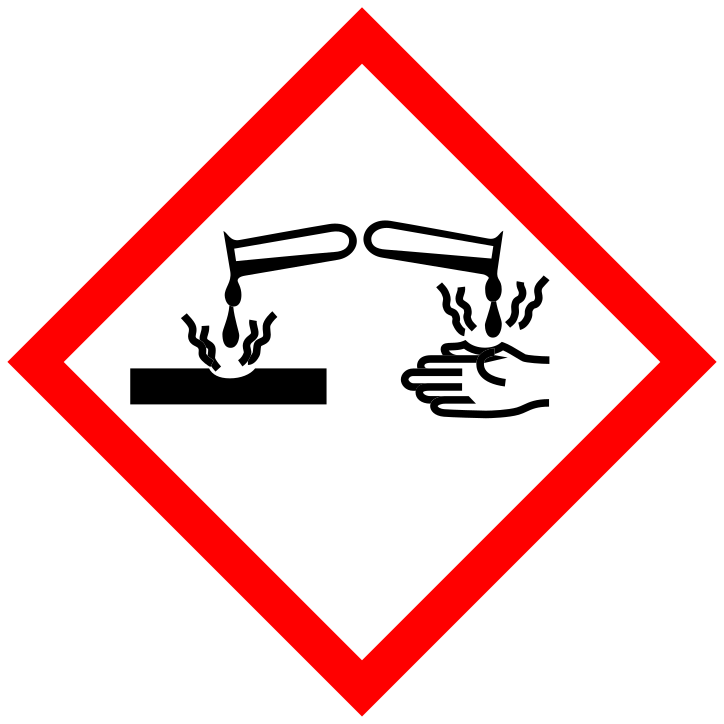 GHS05 GHS05 | Danger | H314 | CriteriaDestruction of skin tissue, namely, visible necrosis through the epidermis and into the dermis, in at least one tested animal after exposure ≤ 4 h — Skin corrosion (section 3.2) (1) See the conditions for the use of Category 1 in paragraph (a) of Section 3.2.2. | |
| 1A | GHS05 | Danger | H314 | CriteriaCorrosive responses in at least one animal following exposure ≤ 3 min during an observation period ≤ 1 h — Skin corrosion (section 3.2) | |
| 1B | GHS05 | Danger | H314 | CriteriaCorrosive responses in at least one animal following exposure > 3 min and ≤ 1 h and observations ≤ 14 days — Skin corrosion (section 3.2) | |
| 1C | GHS05 | Danger | H314 | CriteriaCorrosive responses in at least one animal after exposures > 1 h and ≤ 4 h and observations ≤ 14 days — Skin corrosion (section 3.2) | |
| 2 | GHS07 | Warning | H315 | Criteria(1) Mean score of ≥ 2,3 and ≤ 4,0 for erythema/eschar or for oedema in at least 2 of 3 tested animals from gradings at 24, 48 and 72 hours after patch removal or, if reactions are delayed, from grades on 3 consecutive days after the onset of skin reactions; or (2) Inflammation that persists to the end of the observation period normally 14 days in at least 2 animals, particularly taking into account alopecia (limited area), hyperkeratosis, hyperplasia, and scaling reactions; or (3) In some cases where there is pronounced variability of response among animals, with very definite positive effects related to chemical exposure in a single animal but less than the criteria above. — Skin irritation (section 3.2) (a) Grading criteria are understood as described in Regulation (EC) No 440/2008. |
Serious eye damage/eye irritation
GHS 3.3| Category | Pictogram | Signal word | Hazard statement | Precautionary | Criteria |
|---|---|---|---|---|---|
| 1 | GHS05 | Danger | H318 | CriteriaA substance that produces: (a) in at least one animal effects on the cornea, iris or conjunctiva that are not expected to reverse or have not fully reversed within an observation period of normally 21 days; and/or (b) in at least 2 of 3 tested animals, a positive response of: (i) corneal opacity ≥ 3; and/or (ii) iritis > 1,5; calculated as the mean scores following grading at 24, 48 and 72 hours after instillation of the test material. — Serious eye damage (section 3.3) (a) Grading criteria are understood as described in Regulation (EC) No 440/2008. | |
| 2A | GHS07 | Warning | H319 | CriteriaSubstances that produce in at least 2 of 3 tested animals a positive response of: (a) corneal opacity ≥ 1; and/or (b) iritis ≥ 1; and/or (c) conjunctival redness ≥ 2; and/or (d) conjunctival oedema (chemosis) ≥ 2 calculated as the mean scores following grading at 24, 48 and 72 hours after instillation of the test material, and which fully reverses within an observation period of normally 21 days. — Eye irritation (section 3.3) (a) Grading criteria are understood as described in Regulation (EC) No 440/2008. |
Respiratory sensitisation
GHS 3.4| Category | Pictogram | Signal word | Hazard statement | Precautionary | Criteria |
|---|---|---|---|---|---|
| 1 | 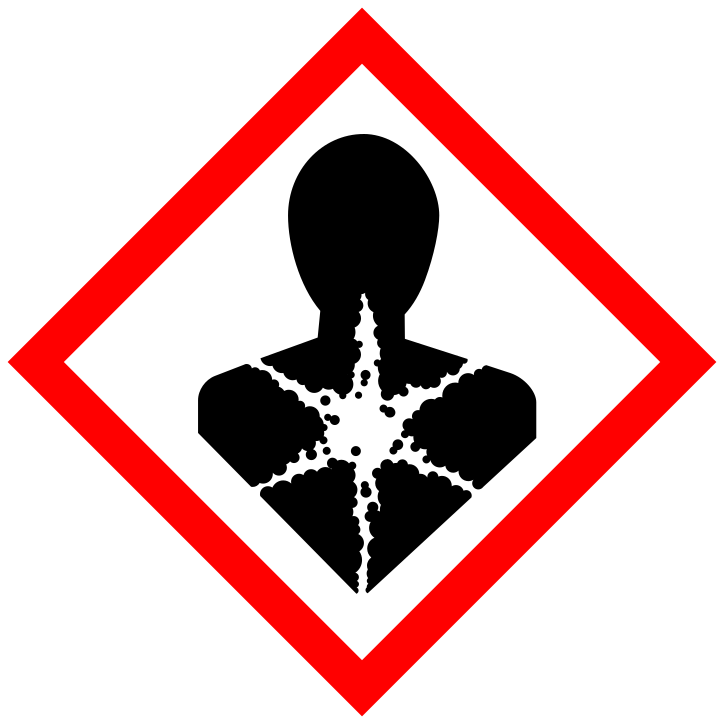 GHS08 GHS08 | Danger | H334 | CriteriaSubstances shall be classified as respiratory sensitisers (Category 1) where data are not sufficient for sub-categorisation in accordance with the following criteria: / (a) if there is evidence in humans that the substance can lead to specific respiratory hypersensitivity; and/or / (b) if there are positive results from an appropriate animal test. — Respiratory sensitisation (section 3.4) | |
| 1A | GHS08 | Danger | H334 | CriteriaSubstances showing a high frequency of occurrence in humans; or a probability of occurrence of a high sensitisation rate in humans based on animal or other tests (1). Severity of reaction may also be considered. — Respiratory sensitisation (section 3.4) (1) At present, recognised and validated animal models for the testing of respiratory hypersensitivity are not available. Under certain circumstances, data from animal studies may provide valuable information in a weight of evidence assessment. | |
| 1B | GHS08 | Danger | H334 | CriteriaSubstances showing a low to moderate frequency of occurrence in humans; or a probability of occurrence of a low to moderate sensitisation rate in humans based on animal or other tests (1). Severity of reaction may also be considered. — Respiratory sensitisation (section 3.4) (1) At present, recognised and validated animal models for the testing of respiratory hypersensitivity are not available. Under certain circumstances, data from animal studies may provide valuable information in a weight of evidence assessment. |
Skin sensitisation
GHS 3.4| Category | Pictogram | Signal word | Hazard statement | Precautionary | Criteria |
|---|---|---|---|---|---|
| 1 | GHS07 | Warning | H317 | CriteriaSubstances shall be classified as skin sensitisers (Category 1) where data are not sufficient for sub-categorisation in accordance with the following criteria: / (a) if there is evidence in humans that the substance can lead to sensitisation by skin contact in a substantial number of persons; or / (b) if there are positive results from an appropriate animal test (see specific criteria in section 3.4.2.2.4.1). — Skin sensitisation (section 3.4) | |
| 1A | GHS07 | Warning | H317 | CriteriaSubstances showing a high frequency of occurrence in humans and/or a high potency in animals can be presumed to have the potential to produce significant sensitisation in humans. Severity of reaction may also be considered. — Skin sensitisation (section 3.4) | |
| 1B | GHS07 | Warning | H317 | CriteriaSubstances showing a low to moderate frequency of occurrence in humans and/or a low to moderate potency in animals can be presumed to have the potential to produce sensitisation in humans. Severity of reaction may also be considered. — Skin sensitisation (section 3.4) |
Germ cell mutagenicity
GHS 3.5| Category | Pictogram | Signal word | Hazard statement | Precautionary | Criteria |
|---|---|---|---|---|---|
| 1A | GHS08 | Danger | H340 | CriteriaSubstances known to induce heritable mutations in the germ cells of humans. / The classification in Category 1A is based on positive evidence from human epidemiological studies. — Germ cell mutagenicity (section 3.5) | |
| 1B | GHS08 | Danger | H340 | CriteriaSubstances to be regarded as if they induce heritable mutations in the germ cells of humans. / The classification in Category 1B is based on: / — positive result(s) from in vivo heritable germ cell mutagenicity tests in mammals; or / — positive result(s) from in vivo somatic cell mutagenicity tests in mammals, in combination with some evidence that the substance has potential to cause mutations to germ cells. It is possible to derive this supporting evidence from mutagenicity/genotoxicity tests in germ cells in vivo, or by demonstrating the ability of the substance or its metabolite(s) to interact with the genetic material of germ cells; or / — positive results from tests showing mutagenic effects in the germ cells of humans, without demonstration of transmission to progeny; for example, an increase in the frequency of aneuploidy in sperm cells of exposed people. — Germ cell mutagenicity (section 3.5) | |
| 2 | GHS08 | Warning | H341 | CriteriaSubstances which cause concern for humans owing to the possibility that they may induce heritable mutations in the germ cells of humans / The classification in Category 2 is based on: / — positive evidence obtained from experiments in mammals and/or in some cases from in vitro experiments, obtained from: / — somatic cell mutagenicity tests in vivo, in mammals; or / — other in vivo somatic cell genotoxicity tests which are supported by positive results from in vitro mutagenicity assays. — Germ cell mutagenicity (section 3.5) |
Carcinogenicity
GHS 3.6| Category | Pictogram | Signal word | Hazard statement | Precautionary | Criteria |
|---|---|---|---|---|---|
| 1A | GHS08 | Danger | H350 | CriteriaCategory 1A, known to have carcinogenic potential for humans, classification is largely based on human evidence, or — Carcinogenicity (section 3.6) | |
| 1B | GHS08 | Danger | H350 | CriteriaCategory 1B, presumed to have carcinogenic potential for humans, classification is largely based on animal evidence. — Carcinogenicity (section 3.6) | |
| 2 | GHS08 | Warning | H351 | CriteriaSuspected human carcinogens / The placing of a substance in Category 2 is done on the basis of evidence obtained from human and/or animal studies, but which is not sufficiently convincing to place the substance in Category 1A or 1B, based on strength of evidence together with additional considerations (see section 3.6.2.2). Such evidence may be derived either from limited (1) evidence of carcinogenicity in human studies or from limited evidence of carcinogenicity in animal studies. — Carcinogenicity (section 3.6) (1) Note: See 3.6.2.2.4. |
Reproductive toxicity
GHS 3.7| Category | Pictogram | Signal word | Hazard statement | Precautionary | Criteria |
|---|---|---|---|---|---|
| 1A | GHS08 | Danger | H360 | CriteriaKnown human reproductive toxicant / The classification of a substance in Category 1A is largely based on evidence from humans. — Reproductive toxicity (section 3.7) | |
| 1B | GHS08 | Danger | H360 | CriteriaPresumed human reproductive toxicant / The classification of a substance in Category 1B is largely based on data from animal studies. Such data shall provide clear evidence of an adverse effect on sexual function and fertility or on development in the absence of other toxic effects, or if occurring together with other toxic effects the adverse effect on reproduction is considered not to be a secondary non-specific consequence of other toxic effects. However, when there is mechanistic information that raises doubt about the relevance of the effect for humans, classification in Category 2 may be more appropriate. — Reproductive toxicity (section 3.7) | |
| 2 | GHS08 | Warning | H361 | CriteriaSuspected human reproductive toxicant / Substances are classified in Category 2 for reproductive toxicity when there is some evidence from humans or experimental animals, possibly supplemented with other information, of an adverse effect on sexual function and fertility, or on development, and where the evidence is not sufficiently convincing to place the substance in Category 1. If deficiencies in the study make the quality of evidence less convincing, Category 2 could be the more appropriate classification. / Such effects shall have been observed in the absence of other toxic effects, or if occurring together with other toxic effects the adverse effect on reproduction is considered not to be a secondary non-specific consequence of the other toxic effects. — Reproductive toxicity (section 3.7) | |
| Lactation | none | none | H362 | CriteriaEffects on or via lactation are allocated to a separate single category. It is recognised that for many substances there is no information on the potential to cause adverse effects on the offspring via lactation. However, substances which are absorbed by women and have been shown to interfere with lactation, or which may be present (including metabolites) in breast milk in amounts sufficient to cause concern for the health of a breastfed child, shall be classified and labelled to indicate this property hazardous to breastfed babies. This classification can be assigned on the: / (a) human evidence indicating a hazard to babies during the lactation period; and/or / (b) results of one or two generation studies in animals which provide clear evidence of adverse effect in the offspring due to transfer in the milk or adverse effect on the quality of the milk; and/or / (c) absorption, metabolism, distribution and excretion studies that indicate the likelihood that the substance is present in potentially toxic levels in breast milk. — Reproductive toxicity — effects on or via lactation (section 3.7) |
Specific target organ toxicity - single exposure
GHS 3.8| Category | Pictogram | Signal word | Hazard statement | Precautionary | Criteria |
|---|---|---|---|---|---|
| 1 | GHS08 | Danger | H370 | CriteriaSubstances that have produced significant toxicity in humans or that, on the basis of evidence from studies in experimental animals, can be presumed to have the potential to produce significant toxicity in humans following single exposure / Substances are classified in Category 1 for specific target organ toxicity (single exposure) on the basis of: / (a) reliable and good quality evidence from human cases or epidemiological studies; or / (b) observations from appropriate studies in experimental animals in which significant and/or severe toxic effects of relevance to human health were produced at generally low exposure concentrations. Guidance dose/concentration values are provided below (see 3.8.2.1.9) to be used as part of weight-of-evidence evaluation. — Specific target organ toxicity — single exposure (section 3.8) | |
| 2 | GHS08 | Warning | H371 | CriteriaSubstances that, on the basis of evidence from studies in experimental animals can be presumed to have the potential to be harmful to human health following single exposure / Substances are classified in Category 2 for specific target organ toxicity (single exposure) on the basis of observations from appropriate studies in experimental animals in which significant toxic effects, of relevance to human health, were produced at generally moderate exposure concentrations. Guidance dose/concentration values are provided below (see 3.8.2.1.9) in order to help in classification. / In exceptional cases, human evidence can also be used to place a substance in Category 2 (see 3.8.2.1.6). — Specific target organ toxicity — single exposure (section 3.8) | |
| 3 | GHS07 | Warning | H335 | CriteriaTransient target organ effects / This category only includes narcotic effects and respiratory tract irritation. These are target organ effects for which a substance does not meet the criteria to be classified in Categories 1 or 2 indicated above. These are effects which adversely alter human function for a short duration after exposure and from which humans may recover in a reasonable period without leaving significant alteration of structure or function. Substances are classified specifically for these effects as laid down in 3.8.2.2. / Criteria for respiratory tract irritation / The criteria for classifying substances as Category 3 for respiratory tract irritation are: / (a) respiratory irritant effects (characterised by localised redness, oedema, pruritis and/or pain) that impair function with symptoms such as cough, pain, choking, and breathing difficulties are included. This evaluation will be based primarily on human data; / (b) subjective human observations could be supported by objective measurements of clear respiratory tract irritation (RTI) (such as electrophysiological responses, biomarkers of inflammation in nasal or bronchoalveolar lavage fluids); / (c) the symptoms observed in humans shall also be typical of those that would be produced in the exposed population rather than being an isolated idiosyncratic reaction or response triggered only in individuals with hypersensitive airways. Ambiguous reports simply of ‘irritation’ shall be excluded as this term is commonly used to describe a wide range of sensations including those such as smell, unpleasant taste, a tickling sensation, and dryness, which are outside the scope of classification for respiratory irritation; / (d) there are currently no validated animal tests that deal specifically with RTI, however, useful information may be obtained from the single and repeated inhalation toxicity tests. For example, animal studies may provide useful information in terms of clinical signs of toxicity (dyspnoea, rhinitis etc) and histopathology (e.g. hyperemia, edema, minimal inflammation, thickened mucous layer) which are reversible and may be reflective of the characteristic clinical symptoms described above. Such animal studies can be used as part of weight of evidence evaluation; / (e) this special classification would occur only when more severe organ effects including in the respiratory system are not observed. — Specific target organ toxicity — single exposure; respiratory tract irritation (section 3.8) | |
| 3 narcotic | GHS07 | Warning | H336 | CriteriaTransient target organ effects / This category only includes narcotic effects and respiratory tract irritation. These are target organ effects for which a substance does not meet the criteria to be classified in Categories 1 or 2 indicated above. These are effects which adversely alter human function for a short duration after exposure and from which humans may recover in a reasonable period without leaving significant alteration of structure or function. Substances are classified specifically for these effects as laid down in 3.8.2.2. / Criteria for narcotic effects / The criteria for classifying substances as Category 3 for narcotic effects are: / (a) central nervous system depression including narcotic effects in humans such as drowsiness, narcosis, reduced alertness, loss of reflexes, lack of coordination, and vertigo are included. These effects can also be manifested as severe headache or nausea, and can lead to reduced judgment, dizziness, irritability, fatigue, impaired memory function, deficits in perception and coordination, reaction time, or sleepiness; / (b) narcotic effects observed in animal studies may include lethargy, lack of coordination, loss of righting reflex, and ataxia. If these effects are not transient in nature, then they shall be considered to support classification for Category 1 or 2 specific target organ toxicity single exposure. — Specific target organ toxicity — single exposure; narcotic effects (section 3.8) |
Specific target organ toxicity - repeated exposure
GHS 3.9| Category | Pictogram | Signal word | Hazard statement | Precautionary | Criteria |
|---|---|---|---|---|---|
| 1 | GHS08 | Danger | H372 | CriteriaSubstances that have produced significant toxicity in humans or that, on the basis of evidence from studies in experimental animals, can be presumed to have the potential to produce significant toxicity in humans following repeated exposure. / Substances are classified in Category 1 for target organ toxicity (repeat exposure) on the basis of: / — reliable and good quality evidence from human cases or epidemiological studies; or / — observations from appropriate studies in experimental animals in which significant and/or severe toxic effects, of relevance to human health, were produced at generally low exposure concentrations. Guidance dose/concentration values are provided below (see 3.9.2.9), to be used as part of a weight-of-evidence evaluation. — Specific target organ toxicity — repeated exposure (section 3.9) | |
| 2 | GHS08 | Warning | H373 | CriteriaSubstances that, on the basis of evidence from studies in experimental animals can be presumed to have the potential to be harmful to human health following repeated exposure. / Substances are classified in category 2 for target organ toxicity (repeat exposure) on the basis of observations from appropriate studies in experimental animals in which significant toxic effects, of relevance to human health, were produced at generally moderate exposure concentrations. Guidance dose/concentration values are provided below (see 3.9.2.9) in order to help in classification. / In exceptional cases human evidence can also be used to place a substance in Category 2 (see 3.9.2.6). — Specific target organ toxicity — repeated exposure (section 3.9) |
Aspiration hazard
GHS 3.10| Category | Pictogram | Signal word | Hazard statement | Precautionary | Criteria |
|---|---|---|---|---|---|
| 1 | GHS08 | Danger | H304 | CriteriaSubstances known to cause human aspiration toxicity hazards or to be regarded as if they cause human aspiration toxicity hazard / A substance is classified in Category 1: / (a) based on reliable and good quality human evidence or / (b) if it is a hydrocarbon and has a kinematic viscosity of 20,5 mm2/s or less, measured at 40 °C. — Aspiration hazard (section 3.10) |
Environmental hazards
3 classesEnvironmental hazard classes cover harm to the aquatic environment and damage to the ozone layer. They are the smallest group by count, but they drive labelling for a large share of everyday industrial chemicals.
Hazardous to the aquatic environment - acute
GHS 4.1| Category | Pictogram | Signal word | Hazard statement | Precautionary | Criteria |
|---|---|---|---|---|---|
| 1 | 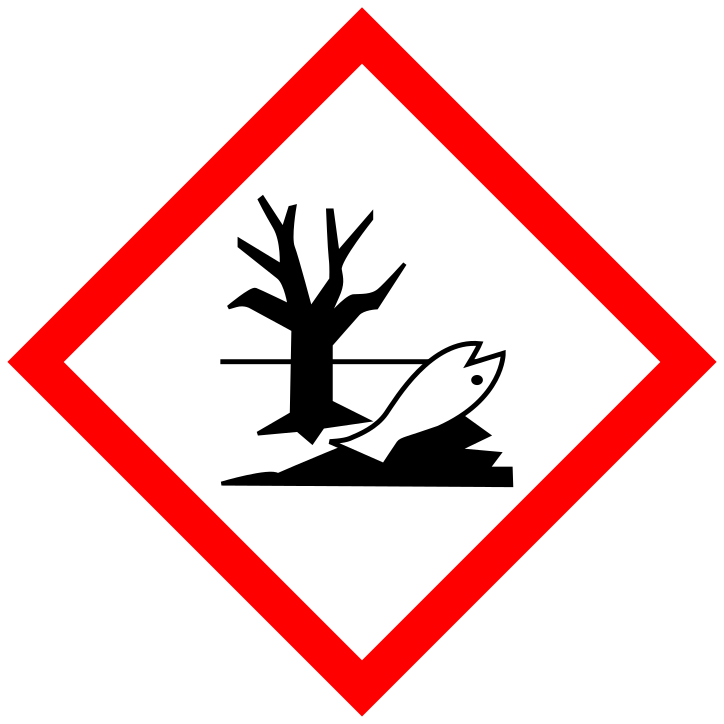 GHS09 GHS09 | Warning | H400 | Criteria(a) Short-term (acute) aquatic hazard / Category Acute 1: (Note 1) / 96 hr LC50 (for fish) ≤ 1 mg/l and/or / 48 hr EC50 (for crustacea) ≤ 1 mg/l and/or / 72 or 96 hr ErC50 (for algae or other aquatic plants) ≤ 1 mg/l. (Note 2) — Hazardous to the aquatic environment — acute aquatic hazard (section 4.1) Note 1: When classifying substances as Acute Category 1 and/or Chronic Category 1 it is necessary at the same time to indicate the appropriate M-factor(s) (see Table 4.1.3). / Note 2: Classification shall be based on the ErC50 [= EC50 (growth rate)]. In circumstances where the basis of the EC50 is not specified or no ErC50 is recorded, classification shall be based on the lowest EC50 available. |
Hazardous to the aquatic environment - chronic
GHS 4.1| Category | Pictogram | Signal word | Hazard statement | Precautionary | Criteria |
|---|---|---|---|---|---|
| 1 | GHS09 | Warning | H410 | Criteria(b) Long-term (chronic) aquatic hazard / (i) Non-rapidly degradable substances (Note 3) for which there are adequate chronic toxicity data available / Category Chronic 1: (Note 1) / Chronic NOEC or ECx (for fish) ≤ 0,1 mg/l and/or / Chronic NOEC or ECx (for crustacea) ≤ 0,1 mg/l and/or / Chronic NOEC or ECx (for algae or other aquatic plants) ≤ 0,1 mg/l. / (ii) Rapidly degradable substances (Note 3) for which there are adequate chronic toxicity data available / Category Chronic 1: (Note 1) / Chronic NOEC or ECx (for fish) ≤ 0,01 mg/l and/or / Chronic NOEC or ECx (for crustacea) ≤ 0,01 mg/l and/or / Chronic NOEC or ECx (for algae or other aquatic plants) ≤ 0,01 mg/l. / (iii) Substances for which adequate chronic toxicity data are not available / Category Chronic 1: (Note 1) / 96 hr LC50 (for fish) ≤ 1 mg/l and/or / 48 hr EC50 (for crustacea) ≤ 1 mg/l and/or / 72 or 96 hr ErC50 (for algae or other aquatic plants) ≤ 1 mg/l. (Note 2) / and the substance is not rapidly degradable and/or the experimentally determined BCF ≥ 500 / (or, if absent, the log Kow ≥ 4). (Note 3). — Hazardous to the aquatic environment — long-term aquatic hazard (section 4.1) Note 1: When classifying substances as Acute Category 1 and/or Chronic Category 1 it is necessary at the same time to indicate the appropriate M-factor(s) (see Table 4.1.3). / Note 2: Classification shall be based on the ErC50 [= EC50 (growth rate)]. In circumstances where the basis of the EC50 is not specified or no ErC50 is recorded, classification shall be based on the lowest EC50 available. / Note 3: When no useful data on degradability are available, either experimentally determined or estimated data, the substance should be regarded as not rapidly degradable. | |
| 2 | GHS09 | none | H411 | Criteria(b) Long-term (chronic) aquatic hazard / (i) Non-rapidly degradable substances (Note 3) for which there are adequate chronic toxicity data available / Category Chronic 2: / Chronic NOEC or ECx (for fish) ≤ 1 mg/l and/or / Chronic NOEC or ECx (for crustacea) ≤ 1 mg/l and/or / Chronic NOEC or ECx (for algae or other aquatic plants) ≤ 1 mg/l. / (ii) Rapidly degradable substances (Note 3) for which there are adequate chronic toxicity data available / Category Chronic 2: / Chronic NOEC or ECx (for fish) ≤ 0,1 mg/l and/or / Chronic NOEC or ECx (for crustacea) ≤ 0,1 mg/l and/or / Chronic NOEC or ECx (for algae or other aquatic plants) ≤ 0,1 mg/l. / (iii) Substances for which adequate chronic toxicity data are not available / Category Chronic 2: / 96 hr LC50 (for fish) > 1 to ≤ 10 mg/l and/or / 48 hr EC50 (for crustacea) > 1 to ≤ 10 mg/l and/or / 72 or 96 hr ErC50 (for algae or other aquatic plants) > 1 to ≤ 10 mg/l. (Note 2) / and the substance is not rapidly degradable and/or the experimentally determined BCF ≥ 500 / (or, if absent, the log Kow ≥ 4). (Note 3). — Hazardous to the aquatic environment — long-term aquatic hazard (section 4.1) Note 2: Classification shall be based on the ErC50 [= EC50 (growth rate)]. In circumstances where the basis of the EC50 is not specified or no ErC50 is recorded, classification shall be based on the lowest EC50 available. / Note 3: When no useful data on degradability are available, either experimentally determined or estimated data, the substance should be regarded as not rapidly degradable. | |
| 3 | none | none | H412 | Criteria(b) Long-term (chronic) aquatic hazard / (ii) Rapidly degradable substances (Note 3) for which there are adequate chronic toxicity data available / Category Chronic 3: / Chronic NOEC or ECx (for fish) ≤ 1 mg/l and/or / Chronic NOEC or ECx (for crustacea) ≤ 1 mg/l and/or / Chronic NOEC or ECx (for algae or other aquatic plants) ≤ 1 mg/l. / (iii) Substances for which adequate chronic toxicity data are not available / Category Chronic 3: / 96 hr LC50 (for fish) > 10 to ≤ 100 mg/l and/or / 48 hr EC50 (for crustacea) > 10 to ≤ 100 mg/l and/or / 72 or 96 hr ErC50 (for algae or other aquatic plants) > 10 to ≤ 100 mg/l. (Note 2) / and the substance is not rapidly degradable and/or the experimentally determined BCF ≥ 500 / (or, if absent, the log Kow ≥ 4). (Note 3). — Hazardous to the aquatic environment — long-term aquatic hazard (section 4.1) Note 2: Classification shall be based on the ErC50 [= EC50 (growth rate)]. In circumstances where the basis of the EC50 is not specified or no ErC50 is recorded, classification shall be based on the lowest EC50 available. / Note 3: When no useful data on degradability are available, either experimentally determined or estimated data, the substance should be regarded as not rapidly degradable. | |
| 4 | none | none | H413 | Criteria(b) Long-term (chronic) aquatic hazard / ‘Safety net’ classification / Category Chronic 4 / Cases when data do not allow classification under the above criteria but there are nevertheless some grounds for concern. This includes, for example, poorly soluble substances for which no acute toxicity is recorded at levels up to the water solubility (note 4), and which are not rapidly degradable in accordance with Section 4.1.2.9.5 and have an experimentally determined BCF ≥ 500 (or, if absent, a log Kow ≥ 4), indicating a potential to bioaccumulate, which will be classified in this category unless other scientific evidence exists showing classification to be unnecessary. Such evidence includes chronic toxicity NOECs > water solubility or > 1 mg/l, or other evidence of rapid degradation in the environment than the ones provided by any of the methods listed in Section 4.1.2.9.5. — Hazardous to the aquatic environment — long-term aquatic hazard (section 4.1) Note 4: ‘No acute toxicity’ is taken to mean that the L(E)C50(s) is/are above the water solubility. Also for poorly soluble substances, (water solubility < 1 mg/l), where there is evidence that the acute test does not provide a true measure of the intrinsic toxicity. |
Hazardous to the ozone layer
GHS 5.1| Category | Pictogram | Signal word | Hazard statement | Precautionary | Criteria |
|---|---|---|---|---|---|
| 1 | GHS07 | Warning | H420 | 1 P-codes | CriteriaA substance shall be classified as hazardous to the ozone layer (Category 1) if the available evidence concerning its properties and its predicted or observed environmental fate and behaviour indicate that it may present a danger to the structure and/or the functioning of the stratospheric ozone layer. — Hazardous to the ozone layer (section 5.1) |
EU-only hazard classes (CLP, not in UN GHS)
4 classesRegulation (EU) 2023/707 added four hazard classes to CLP that have no counterpart in the UN GHS: endocrine disruption for human health, endocrine disruption for the environment, PBT/vPvB and PMT/vPvM properties. They carry an EUH statement and a signal word but no pictogram, and they bind in the EU only — for substances from 1 May 2025 and for mixtures from 1 May 2026.
Endocrine disruption for human health
CLP Annex I 3.11| Category | Pictogram | Signal word | Hazard statement | Precautionary | Criteria |
|---|---|---|---|---|---|
| 1 | none | Danger | EUH380 | CriteriaKnown or presumed endocrine disruptors for human health. Classification in Category 1 shall be largely based on evidence from at least one of the following: (a) human data; (b) animal data; (c) non-animal data providing an equivalent predictive capacity. Such data shall provide evidence that the substance meets all the following criteria: (a) endocrine activity; (b) an adverse effect in an intact organism or its offspring or future generations; (c) a biologically plausible link between the endocrine activity and the adverse effect. Where there is information that raises serious doubt about the relevance of the adverse effects to humans, classification in Category 2 may be more appropriate. — Endocrine disruptor for human health, Category 1 (ED HH 1) | |
| 2 | none | Warning | EUH381 | CriteriaSuspected endocrine disruptors for human health. A substance shall be classified in Category 2 where all the following criteria are fulfilled: (a) there is evidence of (i) an endocrine activity and (ii) an adverse effect in an intact organism or its offspring or future generations; (b) the evidence referred to in point (a) is not sufficiently convincing to classify the substance in Category 1; (c) there is evidence of a biologically plausible link between the endocrine activity and the adverse effect. Where there is evidence conclusively demonstrating that the adverse effects are not relevant to humans, the substance shall not be considered an endocrine disruptor for human health. — Endocrine disruptor for human health, Category 2 (ED HH 2) |
Endocrine disruption for the environment
CLP Annex I 4.2| Category | Pictogram | Signal word | Hazard statement | Precautionary | Criteria |
|---|---|---|---|---|---|
| 1 | none | Danger | EUH430 | CriteriaKnown or presumed endocrine disruptors for the environment. Classification in Category 1 shall be largely based on evidence from at least one of the following: (a) animal data; (b) non-animal data providing an equivalent predictive capacity. Such data shall provide evidence that the substance meets all the following criteria: (a) endocrine activity; (b) an adverse effect in an intact organism or its offspring or future generations; (c) a biologically plausible link between the endocrine activity and the adverse effect. Where there is information that raises serious doubt about the relevance of the adverse effects identified at population or subpopulation level, classification in Category 2 may be more appropriate. — Endocrine disruptor for the environment, Category 1 (ED ENV 1) | |
| 2 | none | Warning | EUH431 | CriteriaSuspected endocrine disruptors for the environment. A substance shall be classified in Category 2 where all the following criteria are met: (a) there is evidence of (i) an endocrine activity and (ii) an adverse effect in an intact organism or its offspring or future generations; (b) the evidence referred to in point (a) is not sufficiently convincing to classify the substance in Category 1; (c) there is evidence of a biologically plausible link between the endocrine activity and the adverse effect. Where there is evidence conclusively demonstrating that the adverse effects identified are not relevant at the population or subpopulation level, the substance shall not be considered an endocrine disruptor for the environment. — Endocrine disruptor for the environment, Category 2 (ED ENV 2) |
Persistent, bioaccumulative and toxic or very persistent, very bioaccumulative properties
CLP Annex I 4.3| Category | Pictogram | Signal word | Hazard statement | Precautionary | Criteria |
|---|---|---|---|---|---|
| PBT | none | Danger | EUH440 | CriteriaA substance shall be considered a PBT substance when it fulfils the persistence, bioaccumulation and toxicity criteria. Persistence (P): degradation half-life in marine water > 60 days, in fresh or estuarine water > 40 days, in marine sediment > 180 days, in fresh or estuarine water sediment > 120 days, or in soil > 120 days. Bioaccumulation (B): bioconcentration factor in aquatic species > 2 000. Toxicity (T): long-term NOEC or ECx for marine or freshwater organisms < 0,01 mg/l; or classification as carcinogenic (1A/1B), germ cell mutagenic (1A/1B) or toxic for reproduction (1A/1B/2); or STOT RE 1 or 2; or endocrine disruptor Category 1 for humans or the environment. Applies to all organic substances, including organo-metals, by weight of evidence. — Persistent, bioaccumulative and toxic (PBT) | |
| vPvB | none | Danger | EUH441 | CriteriaA substance shall be considered a vPvB substance when it fulfils the very persistent and very bioaccumulative criteria. Very persistent (vP): degradation half-life in marine, fresh or estuarine water > 60 days, in marine, fresh or estuarine water sediment > 180 days, or in soil > 180 days. Very bioaccumulative (vB): bioconcentration factor in aquatic species > 5 000. Applies to all organic substances, including organo-metals, by weight of evidence. — Very persistent, very bioaccumulative (vPvB) |
Persistent, mobile and toxic or very persistent, very mobile properties
CLP Annex I 4.4| Category | Pictogram | Signal word | Hazard statement | Precautionary | Criteria |
|---|---|---|---|---|---|
| PMT | none | Danger | EUH450 | CriteriaA substance shall be considered a PMT substance when it fulfils the persistence, mobility and toxicity criteria. Persistence (P): degradation half-life in marine water > 60 days, in fresh or estuarine water > 40 days, in marine sediment > 180 days, in fresh or estuarine water sediment > 120 days, or in soil > 120 days. Mobility (M): log Koc < 3 (for an ionisable substance, the lowest log Koc for pH between 4 and 9 is < 3). Toxicity (T): long-term NOEC or ECx for marine or freshwater organisms < 0,01 mg/l; or classification as carcinogenic (1A/1B), germ cell mutagenic (1A/1B) or toxic for reproduction (1A/1B/2); or STOT RE 1 or 2; or endocrine disruptor Category 1 for human health or the environment. Applies to all organic substances, including organo-metals, by weight of evidence. — Persistent, mobile and toxic (PMT) | |
| vPvM | none | Danger | EUH451 | CriteriaA substance shall be considered a vPvM substance when it fulfils the very persistent and very mobile criteria. Very persistent (vP): degradation half-life in marine, fresh or estuarine water > 60 days, in marine, fresh or estuarine water sediment > 180 days, or in soil > 180 days. Very mobile (vM): log Koc < 2 (for an ionisable substance, the lowest log Koc for pH between 4 and 9 is < 2). Applies to all organic substances, including organo-metals, by weight of evidence. — Very persistent, very mobile (vPvM) |
03 · The awkward cases
Where the register does not line up with the label
In CLP, but no label elements
3 categoriesThese are part of CLP yet carry no pictogram, no signal word and no hazard statement. The substance is still formally classified into the class; the regulator simply concluded that this hazard does not warrant communication on the label. An empty label row here is the correct result.
| Category | Why it carries nothing |
|---|---|
| 1.6 | Classified in CLP, no label elements assigned by the regulation. |
| Type G | Classified in CLP, no label elements assigned by the regulation. |
| Type G | Classified in CLP, no label elements assigned by the regulation. |
In UN GHS, not adopted by the EU
9 categoriesGHS is built as a set of building blocks, and a jurisdiction may adopt a class while leaving out some of its categories. A substance meeting only these criteria is not classified for that hazard in Europe — which is precisely why the same product can legitimately ship with different labels in different regions.
| Hazard class | Categories outside CLP |
|---|---|
| Flammable liquids | 4 |
| Acute toxicity - oral | 5 |
| Acute toxicity - dermal | 5 |
| Acute toxicity - inhalation | 5 |
| Skin corrosion/irritation | 3 |
| Serious eye damage/eye irritation | 2B |
| Aspiration hazard | 2 |
| Hazardous to the aquatic environment - acute | 2, 3 |
04 · Questions
Frequently asked questions
How many hazard classes are there?
There are 33 hazard classes under the Globally Harmonized System: 17 physical, 13 health and 3 environmental. Each class divides into categories that grade severity, and 112 of those categories are recognised in EU CLP. On top of the GHS set, EU CLP has 4 hazard classes of its own, added by Regulation (EU) 2023/707 — endocrine disruption for human health and for the environment, PBT/vPvB and PMT/vPvM — which exist in no other jurisdiction. The GHS classes themselves do not vary by country, although which categories a jurisdiction adopts very much does.
What is GHS classification?
GHS classification is the process of deciding, from test data or other reliable evidence, which hazard classes a substance or mixture falls into and how severe the hazard is within each class. The outcome is a set of assignments such as “Flammable liquid, Category 2”. Those assignments then determine the label mechanically: each category carries a fixed pictogram, signal word, hazard statement and set of precautionary statements. Classification is the judgement step; labelling is the lookup that follows from it.
What is the difference between a hazard class and a hazard category?
A hazard class is the nature of the hazard — what kind of harm it is. A category is the degree of that hazard within the class. Skin corrosion/irritation is a class; Categories 1A, 1B, 1C and 2 are the categories inside it. The distinction matters because duties downstream are usually written in terms of categories, not classes: the same class can be trivial in one category and label-critical in another.
How many GHS pictograms are there?
There are 9 GHS pictograms, each a red diamond with a black symbol on white. A single category may require more than one, and one pictogram serves many classes — the exclamation mark appears for skin irritation, eye irritation, acute toxicity Category 4 and several others. This is why a pictogram alone never tells you the classification: you need the class and category behind it.
Are GHS and CLP the same thing?
No. GHS is a United Nations model — a recommendation that countries adapt. CLP, Regulation (EC) No 1272/2008, is the European law implementing that model, and it is legally binding in the EU. Because GHS is a model rather than a treaty, each jurisdiction picks which building blocks to adopt, which is why 9 categories in this list exist in UN GHS but carry no legal force in Europe.
What are hazard categories used for?
Categories drive three practical things. First the label: pictogram, signal word and hazard statement follow directly from the category. Second the safety data sheet, where section 2 states the classification verbatim. Third the downstream duties — storage segregation, transport classification, workplace exposure controls — which are frequently written per category rather than per class. Getting the category wrong therefore propagates well beyond the label.
Which hazard categories carry no label elements at all?
3 categories sit inside CLP but carry no pictogram, no signal word and no hazard statement: 1.6, Type G, Type G. This is not an omission. They exist so that a substance can be formally classified and assigned to the class, while the regulator concluded the hazard does not warrant communication on the label itself.
Why do some GHS categories not appear in CLP?
9 categories in this list exist in the UN GHS model but were not adopted into EU CLP. GHS is deliberately modular: a jurisdiction may take a class and leave out some of its categories. The EU chose not to adopt certain lower-severity ones, so a substance meeting only those criteria is not classified for that hazard in Europe, even though the same data would trigger a classification elsewhere. They are listed here because a product shipped between regions can legitimately carry two different labels.
What do the signal words Danger and Warning mean?
There are only 2 signal words in the system. “Danger” marks the more severe categories, “Warning” the less severe, and a label carries at most one of them. If a classification produces both, only “Danger” is shown and every “Warning” is dropped. Some categories carry no signal word at all. The signal word is never a judgement made by the label author — it is fixed by the category, which is why it can be looked up rather than decided.
How do hazard classes relate to H-statements and P-statements?
The chain runs one way and is fully deterministic once classification is done. Class and category give you the hazard statement — the H-code and its exact wording. The same category, combined with the conditions of use, gives the precautionary statements: the P-codes covering prevention, response, storage and disposal. Every category row in the tables above links to its H-statement and lists the P-codes attached to it, so the label can be assembled by following links rather than by interpretation.