Physical hazard · Explosives
H201 — Explosive; mass explosion hazard
Physical hazard statements describe what the substance itself can do — explode, ignite, react, corrode metal. 23 substances with a harmonised EU classification carry this code.
01 · Wording
What H201 says
Explosive; mass explosion hazard.
CLP Annex III · Physical hazards
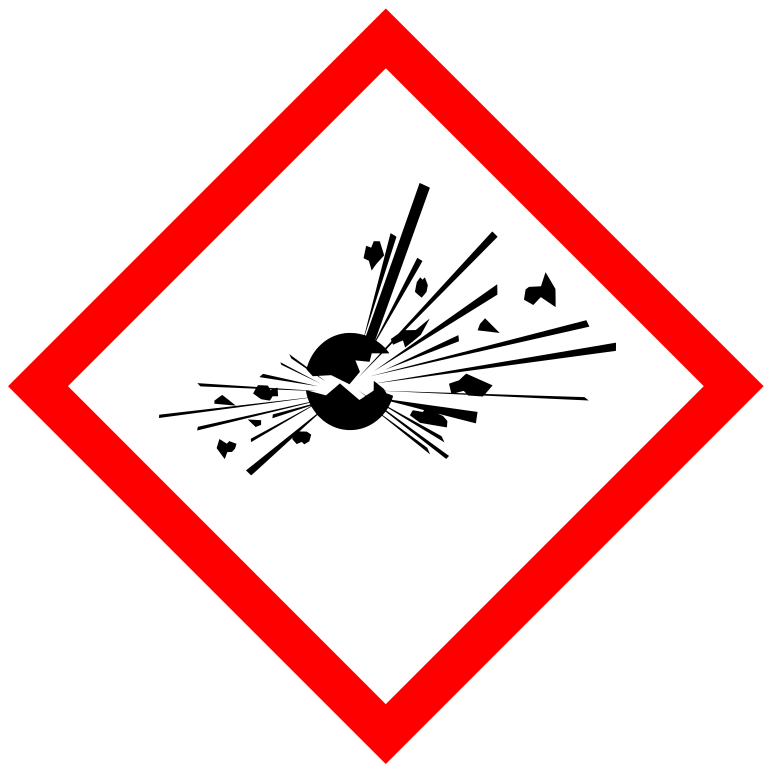
Explosives GHS chapter 2.1
Category 1.1 · pictogram GHS01 (exploding bomb) · signal word Danger
Deleted from UN GHS in Rev.9 (2021) — still current in CLP.
UN GHS Rev.9 marked this code [Deleted]. EU CLP has not followed: the code is legally current on an EU label today. This is the single most common reason a code looks wrong in one reference and right in another.
The UN replacement is H209, a code that is not part of EU CLP.
Nine editions of the UN model text, 86 hazard statements, 19 of which ever moved. Read the full story in what changed in UN GHS Rev.11.
02 · Languages
H201 in the 24 official EU languages
A label put on the market in an EU country must carry the wording of that country's own language version of CLP — not a translation of the English one. These 24 lines are quoted from the consolidated regulation, Annex III, and are the text to print.
| Language | Official wording of H201 |
|---|---|
| BG български Bulgarian | Експлозив; опасност от масова експлозия. |
| ES español Spanish | Explosivo; peligro de explosión en masa. |
| CS čeština Czech | Výbušnina; nebezpečí masivního výbuchu. |
| DA dansk Danish | Eksplosiv, masseeksplosionsfare. |
| DE Deutsch German | Explosiv, Gefahr der Massenexplosion. |
| ET eesti Estonian | Plahvatusohtlik; massiplahvatusoht. |
| EL ελληνικά Greek | Εκρηκτικό· κίνδυνος μαζικής έκρηξης. |
| EN English English | Explosive; mass explosion hazard. |
| FR français French | Explosif; danger d'explosion en masse. |
| GA Gaeilge Irish | Pléascach; guais mhórphléasctha. |
| HR hrvatski Croatian | Eksplozivno; opasnost od eksplozije ogromnih razmjera. |
| IT italiano Italian | Esplosivo; pericolo di esplosione di massa. |
| LV latviešu Latvian | Sprādzienbīstams; masveida sprādzienbīstamība. |
| LT lietuvių Lithuanian | Sprogios medžiagos, kelia masinio sprogimo pavojų. |
| HU magyar Hungarian | Robbanóanyag; teljes tömeg felrobbanásának veszélye. |
| MT Malti Maltese | Splussiv; periklu li jisplodu kollha f'daqqa. |
| NL Nederlands Dutch | Ontplofbare stof; gevaar voor massa-explosie. |
| PL polski Polish | Materiał wybuchowy; zagrożenie wybuchem masowym. |
| PT português Portuguese | Explosivo; perigo de explosão em massa. |
| RO română Romanian | Exploziv; pericol de explozie în masă. |
| SK slovenčina Slovak | Výbušnina, nebezpečenstvo rozsiahleho výbuchu. |
| SL slovenščina Slovenian | Eksplozivno; nevarnost eksplozije v masi. |
| FI suomi Finnish | Räjähde; massaräjähdysvaara. |
| SV svenska Swedish | Explosivt. Fara för massexplosion. |
Source: CELEX:02008R1272-20260501, Annex III. © European Union, https://eur-lex.europa.eu — only the electronic Official Journal of the European Union is authentic. Irish is one of the 24 official languages and its H and P texts are printed inside the multilingual Annex tables, but no consolidated CLP has ever been published in Irish — which is why an Irish-primary label cannot be built here.
03 · Legal status
Where H201 is current
GHS is a United Nations model text, revised every two years, and each jurisdiction adopts a revision on its own timetable. A code can be legally current in one system and deleted in another — that is normal, not an error.
| Jurisdiction | Basis | Status of H201 |
|---|---|---|
| EU CLP | Regulation (EC) 1272/2008 CLP Annex IV, Part 2 (consolidated) | Current |
| US OSHA HazCom | 29 CFR 1910.1200 Appendix C UN GHS Rev.7 (final rule of 20 May 2024) | Current |
| US HazCom 2012 | legacy · GHS Rev.3 UN GHS Rev.3, Annex 3 | Current |
| UN GHS | Rev.11 (2025) UN GHS Rev.11, Annex 3 | withdrawn Current equivalent: H209. |
Currently in force under: EU CLP, US OSHA HazCom, US HazCom 2012. Sources: EU CLP · US OSHA HazCom · US HazCom 2012 · UN GHS
04 · Substances
Substances carrying H201
Every entry whose harmonised CLP Annex VI classification includes this hazard statement. Substances with a reference page here open on this site; the rest open on ghssymbols.com. Of these, 1 is a group entry such as “salts of picric acid” or “beryllium compounds” — Annex VI gives them no CAS number, so they are listed by Index No and have no page of their own.
- 1-Fluoro-4-hydroxy-1,4-diazoniabicyclo[2.2.2]octane… CAS 162241-33-0
- 1,2,3,4-Tetranitro-9H-carbazole CAS 6202-15-9
- 1,3,5-Trinitrobenzene CAS 99-35-4
- 2-amino-4,6-dinitrophenol CAS 96-91-3
- 2-chloro-1,3,5-trinitrobenzene CAS 88-88-0
- 2,2-Dibromo-2-nitroethanol CAS 69094-18-4
- 2,4,6-Trinitro-m-cresol CAS 602-99-3
- 2,4,6-Trinitro-m-xylene CAS 632-92-8
- 2,4,6-Trinitroanisole CAS 606-35-9
- 2,4,6-trinitrophenol CAS 88-89-1
- 2,4,6-trinitroresorcinol CAS 82-71-3
- 2,4,6-Trinitrotoluene CAS 118-96-7
- 4,4'-oxybis(benzenesulfonylazide) CAS 7456-68-0
- Ammonium perchlorate CAS 7790-98-9
- Benzenesulfonic acid, 2,4-diamino-5-(2-(4-((2-(sulfooxy… CAS 27624-67-5
- bis(2,4,6-trinitrophenyl)amine CAS 131-73-7
- dipicrylamine, ammonium salt CAS 2844-92-0
- hydrazine-trinitromethane Index No 609-053-00-X
- hydroxylammonium hydrogensulfate CAS 10046-00-1
- Hydroxylammonium nitrate CAS 13465-08-2
- Mercury cyanide oxide (Hg2(CN)2O) CAS 1335-31-5
- Musk Xylene CAS 81-15-2
- N-methyl-N-2,4,6-tetranitroaniline CAS 479-45-8
Nothing matches that filter.
All hazard statements
The full list of H-codes with the jurisdiction switch lives on the hazard statements hub. For what to do about the hazard, see precautionary statements (P-codes).
Wording quoted from the regulation named above. Substance counts come from harmonised classifications in CLP Annex VI — the statements on a real product also depend on the supplier's own classification. Always check the supplier safety data sheet.