Physical hazard · Explosives
H200 — Unstable explosives
Physical hazard statements describe what the substance itself can do — explode, ignite, react, corrode metal. 12 substances with a harmonised EU classification carry this code.
01 · Wording
What H200 says
Unstable explosives.
CLP Annex III · Physical hazards
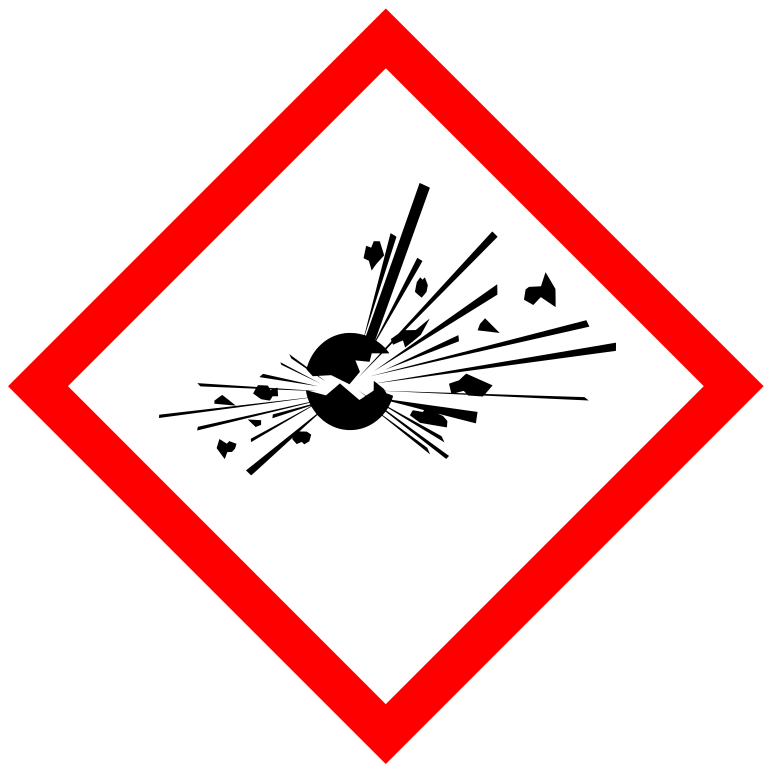
Explosives GHS chapter 2.1
Category Unstable explosive · pictogram GHS01 (exploding bomb) · signal word Danger
Deleted from UN GHS in Rev.9 (2021) — still current in CLP.
UN GHS Rev.9 marked this code [Deleted]. EU CLP has not followed: the code is legally current on an EU label today. This is the single most common reason a code looks wrong in one reference and right in another.
The UN replacement is H209, a code that is not part of EU CLP.
Nine editions of the UN model text, 86 hazard statements, 19 of which ever moved. Read the full story in what changed in UN GHS Rev.11.
02 · Languages
H200 in the 24 official EU languages
A label put on the market in an EU country must carry the wording of that country's own language version of CLP — not a translation of the English one. These 24 lines are quoted from the consolidated regulation, Annex III, and are the text to print.
| Language | Official wording of H200 |
|---|---|
| BG български Bulgarian | Нестабилен експлозив. |
| ES español Spanish | Explosivo inestable. |
| CS čeština Czech | Nestabilní výbušnina. |
| DA dansk Danish | Ustabilt eksplosiv. |
| DE Deutsch German | Instabil, explosiv. |
| ET eesti Estonian | Ebapüsiv lõhkeaine. |
| EL ελληνικά Greek | Ασταθή εκρηκτικά. |
| EN English English | Unstable explosives. |
| FR français French | Explosif instable. |
| GA Gaeilge Irish | Pléascáin éagobhsaí. |
| HR hrvatski Croatian | Nestabilni eksplozivi. |
| IT italiano Italian | Esplosivo instabile. |
| LV latviešu Latvian | Nestabili sprādzienbīstami materiāli. |
| LT lietuvių Lithuanian | Nestabilios sprogios medžiagos. |
| HU magyar Hungarian | Instabil robbanóanyagok. |
| MT Malti Maltese | Splussivi instabbli. |
| NL Nederlands Dutch | Instabiele ontplofbare stof. |
| PL polski Polish | Materiały wybuchowe niestabilne. |
| PT português Portuguese | Explosivo instável. |
| RO română Romanian | Exploziv instabil. |
| SK slovenčina Slovak | Nestabilné výbušniny. |
| SL slovenščina Slovenian | Nestabilni eksplozivi. |
| FI suomi Finnish | Epästabiili räjähde. |
| SV svenska Swedish | Instabilt explosivt. |
Source: CELEX:02008R1272-20260501, Annex III. © European Union, https://eur-lex.europa.eu — only the electronic Official Journal of the European Union is authentic. Irish is one of the 24 official languages and its H and P texts are printed inside the multilingual Annex tables, but no consolidated CLP has ever been published in Irish — which is why an Irish-primary label cannot be built here.
03 · Legal status
Where H200 is current
GHS is a United Nations model text, revised every two years, and each jurisdiction adopts a revision on its own timetable. A code can be legally current in one system and deleted in another — that is normal, not an error.
| Jurisdiction | Basis | Status of H200 |
|---|---|---|
| EU CLP | Regulation (EC) 1272/2008 CLP Annex IV, Part 2 (consolidated) | Current |
| US OSHA HazCom | 29 CFR 1910.1200 Appendix C UN GHS Rev.7 (final rule of 20 May 2024) | Current |
| US HazCom 2012 | legacy · GHS Rev.3 UN GHS Rev.3, Annex 3 | Current |
| UN GHS | Rev.11 (2025) UN GHS Rev.11, Annex 3 | withdrawn Current equivalent: H209. |
Currently in force under: EU CLP, US OSHA HazCom, US HazCom 2012. Sources: EU CLP · US OSHA HazCom · US HazCom 2012 · UN GHS
04 · Substances
Substances carrying H200
Every entry whose harmonised CLP Annex VI classification includes this hazard statement. Substances with a reference page here open on this site; the rest open on ghssymbols.com. Of these, 1 is a group entry such as “salts of picric acid” or “beryllium compounds” — Annex VI gives them no CAS number, so they are listed by Index No and have no page of their own.
- Dichloroacetylene CAS 7572-29-4
- Diethylene glycol dinitrate CAS 693-21-0
- Ethyl Nitrate CAS 625-58-1
- Ethylene glycol dinitrate CAS 628-96-6
- glycerol trinitrate CAS 55-63-0
- hydroxylamine ....% [> 55 % in aqueous solution] CAS 7803-49-8
- lead 2,4,6-trinitro-m-phenylene dioxide CAS 15245-44-0
- lead diazide CAS 13424-46-9
- Mannitol Hexanitrate CAS 15825-70-4
- mercury difulminate CAS 628-86-4
- Pentaerythritol Tetranitrate CAS 78-11-5
- salts of picric acid Index No 609-010-00-5
Nothing matches that filter.
All hazard statements
The full list of H-codes with the jurisdiction switch lives on the hazard statements hub. For what to do about the hazard, see precautionary statements (P-codes).
Wording quoted from the regulation named above. Substance counts come from harmonised classifications in CLP Annex VI — the statements on a real product also depend on the supplier's own classification. Always check the supplier safety data sheet.