Health hazard · Specific target organ toxicity - single exposure
H371 — May cause damage to organs
Health hazard statements describe what the substance does to a person exposed to it. 6 substances with a harmonised EU classification carry this code.
01 · Wording
What H371 says
May cause damage to organs <or state all organs affected, if known> <state route of exposure if it is conclusively proven that no other routes of exposure cause the hazard>. The wording is incomplete on purpose. The organ or organs affected, if known, and the route of exposure where it is conclusively proven that no other route causes the hazard.
May cause damage to organs. How it usually reads on a label and on a safety data sheet. We show it separately rather than presenting a filled-in blank as the regulation's own text.
CLP Annex III · Health hazards
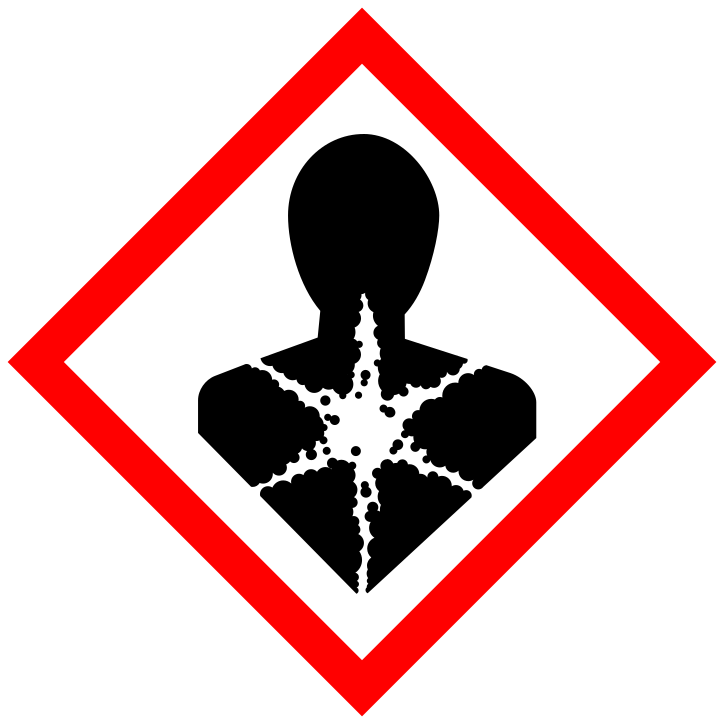
Specific target organ toxicity - single exposure GHS chapter 3.8
Category 2 · pictogram GHS08 (health hazard) · signal word Warning
Reading the official wording. <angle brackets> mark a blank the supplier fills in — not a truncated sentence.· UN GHS prints the same blanks in round brackets, CLP in angle ones.· P-codes use a different notation — an ellipsis and square brackets.
Unchanged since 2009.
Present in every UN GHS edition from Rev.3 (2009) to Rev.11 (2025), with the same wording throughout.
Nine editions of the UN model text, 86 hazard statements, 19 of which ever moved. Read the full story in what changed in UN GHS Rev.11.
02 · Languages
H371 in the 24 official EU languages
A label put on the market in an EU country must carry the wording of that country's own language version of CLP — not a translation of the English one. These 24 lines are quoted from the consolidated regulation, Annex III, and are the text to print.
| Language | Official wording of H371 |
|---|---|
| BG български Bulgarian | Може да причини увреждане на органите < или да се посочат всички засегнати органи, ако са известни> < да се посочи пътят на експозицията, ако е доказано убедително, че няма друг път на експозиция, който води до същата опасност >. |
| ES español Spanish | Puede provocar daños en los órganos <o indíquense todos los órganos afectados, si se conocen> <indíquese la vía de exposición si se ha demostrado concluyentemente que el peligro no se produce por ninguna otra vía>. |
| CS čeština Czech | Může způsobit poškození orgánů <nebo uvést všechny postižené orgány, jsou-li známy> <uveďte cestu expozice, je-li přesvědčivě prokázáno, že ostatní cesty expozice nejsou nebezpečné>. |
| DA dansk Danish | Kan forårsage organskader <eller angiv alle berørte organer, hvis de kendes> <angiv eksponeringsvej, hvis det er endeligt påvist, at faren ikke kan frembringes ad nogen anden eksponeringsvej>. |
| DE Deutsch German | Kann die Organe schädigen <oder alle betroffenen Organe nennen, sofern bekann> <Expositionsweg angeben, sofern schlüssig belegt ist, dass diese Gefahr bei keinem anderen Expositionsweg besteht>. |
| ET eesti Estonian | Võib kahjustada elundeid <või märkida kõik mõjutatud elundid, kui need on teada> <märkida kokkupuuteviis, kui on veenvalt tõestatud, et muud kokkupuuteviisid ei ole ohtlikud>. |
| EL ελληνικά Greek | Μπορεί να προκαλέσει βλάβες στα όργανα <ή αναφέρονται όλα τα όργανα που βλάπτονται, εάν είναι γνωστά> <αναφέρεται η οδός έκθεσης αν έχει αποδειχθεί αδιαμφισβήτητα ότι δεν υπάρχει κίνδυνος από τις άλλες οδούς έκθεσης>. |
| EN English English | May cause damage to organs <or state all organs affected, if known> <state route of exposure if it is conclusively proven that no other routes of exposure cause the hazard>. |
| FR français French | Risque présumé d'effets graves pour les organes <ou indiquer tous les organes affectés, s'ils sont connus> <indiquer la voie d'exposition s'il est formellement prouvé qu'aucune autre voie d'exposition ne conduit au même danger>. |
| GA Gaeilge Irish | D'fhéadfadh damáiste a dhéanamh d'orgáin <nó tabhair na horgáin go léir a bhuailtear, más eol> <tabhair an bealach nochta má tá sé cruthaithe go cinntitheach nach bealach nochta ar bith eile is cúis leis an nguais>. |
| HR hrvatski Croatian | Može uzrokovati oštećenje organa <ili navesti sve organe na koje djeluje ako je poznato> <navesti način izloženosti ako je nedvojbeno dokazano da niti jedan drugi način izloženosti ne uzrokuje takvu opasnost>. |
| IT italiano Italian | Può provocare danni agli organi <o indicare tutti gli organi interessati, se noti> <indicare la via di esposizione se è accertato che nessun'altra via di esposizione comporta il medesimo pericolo>. |
| LV latviešu Latvian | Var izraisīt orgānu bojājumus <vai norādīt visus skartos orgānus, ja tie ir zināmi> <norādīt iedarbības ceļu, ja ir nepārprotami pierādīts, ka citi iedarbības ceļi nerada bīstamību>. |
| LT lietuvių Lithuanian | Gali pakenkti organams <arba nurodyti visus veikiamus organus, jeigu žinomi> <nurodyti veikimo būdą, jeigu įtikinamai nustatyta, kad kiti veikimo būdai nepavojingi>. |
| HU magyar Hungarian | Károsíthatja a szerveket < vagy meg kell adni az összes érintett szervet, ha ismertek > < meg kell adni az expozíciós útvonalat, ha meggyőzően bizonyított, hogy más expozíciós útvonal nem okozza a veszélyt >. |
| MT Malti Maltese | Jista’ jikkawża ħsara lill-organi <jew semmi l-organi kollha affettwati, jekk ikunu magħrufa> <semmi l-mod ta' espożizzjoni jekk ikun pruvat b'mod konklużiv li l-ebda mod ta'’ espożizzjoni ieħor ma jikkawża l-periklu>. |
| NL Nederlands Dutch | Kan schade aan organen <of alle betrokken organen vermelden indien bekend> veroorzaken <blootstellingsroute vermelden indien afdoende bewezen is dat het gevaar bij andere blootstellingsroutes niet aanwezig is>. |
| PL polski Polish | Może powodować uszkodzenie narządów <podać wszystkie znane narządy, których to dotyczy> <podać drogę narażenia, jeżeli udowodniono, że inne drogi narażenia nie stwarzają zagrożenia>. |
| PT português Portuguese | Pode afectar os órgãos <ou indicar todos os órgãos afectados, se forem conhecidos> <indicar a via de exposição se existirem provas concludentes de que o perigo não decorre de nenhuma outra via de exposição>. |
| RO română Romanian | Poate provoca leziuni ale organelor <sau indicați toate organele afectate, dacă sunt cunoscute> <indicați calea de expunere, dacă există probe concludente că nicio altă cale de expunere nu provoacă acest pericol>. |
| SK slovenčina Slovak | Môže spôsobiť poškodenie orgánov <alebo uveďte všetky zasiahnuté orgány, ak sú známe> <uveďte spôsob expozície, ak sa presvedčivo preukáže, že iné spôsoby expozície nevyvolávajú nebezpečenstvo>. |
| SL slovenščina Slovenian | Lahko škoduje organom <ali navesti vse organe, na katere vpliva, če je znano> <navesti način izpostavljenosti, če je prepričljivo dokazano, da noben drug način izpostavljenosti ne povzroča takšne nevarnosti>. |
| FI suomi Finnish | Saattaa vahingoittaa elimiä <tai mainitaan kaikki tiedetyt kohde-elimet> <mainitaan altistumisreitti, jos on kiistatta osoitettu, että vaara ei voi aiheutua muiden altistumisreittien kautta>. |
| SV svenska Swedish | Kan orsaka organskador <eller ange vilka organ som påverkas om detta är känt> <ange exponeringsväg om det är definitivt bevisat att faran inte kan orsakas av några andra exponeringsvägar>. |
Source: CELEX:02008R1272-20260501, Annex III. © European Union, https://eur-lex.europa.eu — only the electronic Official Journal of the European Union is authentic. Irish is one of the 24 official languages and its H and P texts are printed inside the multilingual Annex tables, but no consolidated CLP has ever been published in Irish — which is why an Irish-primary label cannot be built here.
03 · Legal status
Where H371 is current
GHS is a United Nations model text, revised every two years, and each jurisdiction adopts a revision on its own timetable. A code can be legally current in one system and deleted in another — that is normal, not an error.
| Jurisdiction | Basis | Status of H371 |
|---|---|---|
| EU CLP | Regulation (EC) 1272/2008 CLP Annex IV, Part 2 (consolidated) | Current |
| US OSHA HazCom | 29 CFR 1910.1200 Appendix C UN GHS Rev.7 (final rule of 20 May 2024) | Current |
| US HazCom 2012 | legacy · GHS Rev.3 UN GHS Rev.3, Annex 3 | Current |
| UN GHS | Rev.11 (2025) UN GHS Rev.11, Annex 3 | Current |
Currently in force under: EU CLP, US OSHA HazCom, US HazCom 2012, UN GHS. Sources: EU CLP · US OSHA HazCom · US HazCom 2012 · UN GHS
04 · Substances
Substances carrying H371
Every entry whose harmonised CLP Annex VI classification includes this hazard statement. Substances with a reference page here open on this site; the rest open on ghssymbols.com. Of these, 1 is a group entry such as “salts of picric acid” or “beryllium compounds” — Annex VI gives them no CAS number, so they are listed by Index No and have no page of their own.
- (1,3,4,5,6,7-hexahydro-1,3-dioxo-2H-isoindol-2-yl)meth… CAS 1166-46-7
- 2,3,5,6-tetrafluoro-4-(methoxymethyl)benzyl… CAS 1065124-65-3
- 3-(2-chloroethyl)-2-methyl-4H,6H,7H,8H,9H-pyrido(1,2-a)… CAS 93076-03-0
- Imiprothrin CAS 72963-72-5
- reaction mass of: succinic acidmonopersuccinic… Index No 607-613-00-8
- Tetramethrin CAS 7696-12-0
Nothing matches that filter.
All hazard statements
The full list of H-codes with the jurisdiction switch lives on the hazard statements hub. For what to do about the hazard, see precautionary statements (P-codes).
Wording quoted from the regulation named above. Substance counts come from harmonised classifications in CLP Annex VI — the statements on a real product also depend on the supplier's own classification. Always check the supplier safety data sheet.