Substance profile
Phosmet
Phosmet is an off-white crystalline solid with an offensive odor.
01 · Identification
What Phosmet is
Phosmet is an off-white crystalline solid with an offensive odor. Its molecular formula is C11H12NO4PS2 and its molecular weight is 317.3 g/mol. It melts at 71.9 °C.
Under the GHS it carries the signal word Danger.
02 · Identifiers
Phosmet identifiers and molecular data
Phosmet CAS number and EC number
Phosmet molecular formula and molecular weight
Other names for Phosmet
- phosmet (ISO)
- S-[(1,3-dioxo-1,3-dihydro-2H-isoindol-2-yl)methyl] O,O-di-methyl phosphorodithioate
- O,O-dimethyl-S-phthalimido-methyl phosphorodithioate
03 · GHS classification
Phosmet hazard classification
Harmonised classification under CLP Annex VI. This is the legally binding classification in the EU; other jurisdictions may differ.
Phosmet pictograms and signal word
Phosmet hazard class and category
| Hazard class | Category | From code | Pictogram |
|---|---|---|---|
| Acute toxicity - oral GHS chapter 3.1 | Category 3 | H301 | GHS06 |
| Acute toxicity - inhalation GHS chapter 3.1 | Category 4 | H332 | GHS07 |
| Specific target organ toxicity - single exposure GHS chapter 3.8 | Category 1 | H370 | GHS08 |
| Hazardous to the aquatic environment - acute GHS chapter 4.1 | Category 1 | H400 | GHS09 |
| Hazardous to the aquatic environment - chronic GHS chapter 4.1 | Category 1 | H410 | GHS09 |
Phosmet hazard statements (H-codes)
| Code | Hazard statement |
|---|---|
| H361f | Suspected of damaging fertility. |
| H301 | Toxic if swallowed. |
| H332 | Harmful if inhaled. |
| H370 | Causes damage to organs <or state all organs affected, if known> <state route of exposure if it is conclusively proven that no other routes of exposure cause the hazard>. |
| H400 | Very toxic to aquatic life. |
| H410 | Very toxic to aquatic life with long lasting effects. |
This page lists only the codes assigned to Phosmet. The full reference lives on the hazard statements hub, the precautionary statements hub and the GHS pictograms hub.
Safety Data Sheet
Getting an SDS for Phosmet
A Safety Data Sheet is written for a product, not for a substance: the supplier of the grade you actually buy issues it, so two suppliers of Phosmet issue two different sheets. That is why there is no single authoritative SDS for a substance to download — what there is, is the job of collecting the sheets for the products you hold and keeping them current as suppliers revise them.
04 · Precautionary statements
Phosmet precautionary statements
CLP Annex VI assigns 13 precautionary statements to Phosmet. They are grouped the way a label groups them: what to do before handling, what to do when something has already happened, how to store it and how to dispose of it.
Prevention
What to do before and during handling so the hazard never happens.
Response
What to do once exposure, spillage or fire has already happened.
Disposal
What has to happen to the contents and the empty container.
Reading the notation. … is a blank the supplier fills in — not a truncated sentence.· [square brackets] mark a part printed only when it applies.
05 · Names in the regulation
Phosmet name in 23 EU languages
CLP Annex VI Part 3 is published in every language edition of the regulation, and the identification column is written out in each of them. Nothing below is translated by us: each line is the name as that edition prints it. Under Art. 18(2) the substance name from Annex VI is a lawful product identifier, so this is the wording to put on a label going to that market — and where the cell lists several designations, any one of them qualifies.
| Language | Name in CLP Annex VI Part 3 |
|---|---|
| Bulgarian български | фосмет (ISO) S -[(1,3-диоксо-1,3-дихидро-2 H -изоиндол-2-ил)метилов] O , O -диметилов фосфородитиоатO , O -диметил- S -фталимидометилов фосфородитионат |
| Spanish español | Fosmet (ISO) fosforoditioato de S -[(1,3-dioxo-1,3-dihidro-2 H -isoindol-2-il)metilo] y O , O -dimetilofosforoditioato de O , O -dimetilo y S -ftalimidometilo |
| Czech čeština | fosmet (ISO) S -ftalimidomethyl- O , O -dimethyl-fosforodithioát |
| Danish dansk | phosmet (ISO) S -[(1,3-dioxo-1,3-dihydro-2 H -isoindol-2-yl)methyl]- O , O -dimethyldithiophosphatO , O -dimethylphthalimidomethyldithiophosphat |
| German Deutsch | Phosmet (ISO) S -[(1,3-Dioxo-1,3-dihydro-2 H -isoindol-2-yl)methyl] O , O -DimethyldithiophosphatO , O -Dimethyl- S -phthalimidomethyldithiophosphat |
| Estonian eesti | fosmeet (ISO) S -[(1,3-diokso-1,3-dihüdro-2 H -isoindool-2-üül)metüül] O , O -dimetüülfosforoditioaatO , O -dimetüül- S -ftaalimidometüülfosforoditioaat |
| Greek ελληνικά | phosmet (φοσμέτ) (ISO) διθειοφωσφορικό S -[(1,3-διοξο-1,3-διυδρο-2 H -ισοϊνδολ-2-υλο)μεθύλιο] O , O -διμεθύλιοδιθειοφωσφορικό O , O -διμεθυλο- S -φθαλιμιδομεθύλιο |
| English English | phosmet (ISO) S -[(1,3-dioxo-1,3-dihydro-2 H -isoindol-2-yl)methyl] O , O -dimethyl phosphorodithioateO , O -dimethyl- S -phthalimidomethyl phosphorodithioate |
| French français | phosmet (ISO) phosphorodithioate de S -[(1,3-dioxo-1,3-dihydro-2 H -isoindol-2-yl)méthyle] et de O , O -diméthylephosphorodithioate de O , O -diméthyle et de S -phthalimidométhyle |
| Croatian hrvatski | fosmet (ISO) S -[(1,3-diokso-1,3-dihidro-2 H -izoindol-2-il)metil] O , O -dimetil-fosforoditioatO , O -dimetil- S -ftalimidometil-fosforoditioat |
| Italian italiano | Fosmet (ISO) S -[(1,3-diosso-1,3-diidro-2 H -isoindol-2-il)metile] O , O -dimetil fosforoditioatoO , O -dimetil- S -ftalimmidometil fosforoditioato |
| Latvian latviešu | fosmets (ISO) S -[(1,3-diokso-1,3-dihidro-2 H -izoindol-2-il)metil] O , O -dimetilfosforditioātsO , O -dimetil- S -ftalimidometilfosforditioāts |
| Lithuanian lietuvių | fosmetas (ISO) S -[(1,3-diokso-1,3-dihidro-2 H -izoindol-2-il)metil]- O , O -dimetilditiofosfatasO , O -dimetil- S -ftalimidometilditiofosfatas |
| Hungarian magyar | foszmet (ISO) S -[(1,3-dioxo-1,3-dihidro-2 H -izoindol-2-il)metil] O , O -dimetil-ditiofoszfátO,O -dimetil- S -ftalimidometil-ditiofoszfát |
| Maltese Malti | fosmet (ISO) S -[(1,3-diosso-1,3-diidro-2 H -isoindol-2-il)metil] O , O -dimetil fosforoditioatO , O -dimetil- S -ftalimidometil fosforoditioat |
| Dutch Nederlands | fosmet (ISO) S -[(1,3-dioxo-1,3-dihydro-2 H -isoïndool-2-yl)methyl]- O , O -dimethyldithiofosfaatO , O -dimethyl- S -ftaalimidomethyldithiofosfaat |
| Polish polski | fosmet (ISO) fosforoditionian S -[(1,3-diokso-1,3-dihydro-2 H -izoindol-2-ylo)metylo] O , O -dimetylu ditiofosforan S -ftalimidometylu- O , O -dimetylu |
| Portuguese português | fosmete (ISO) fosforoditioato de S-[(1,3-dioxo-1,3-di-hidro-2H-isoindol-2-il)metilo] e de O,O-dimetilofosforoditioato de O,O-dimetil-S-ftalimidometilo |
| Romanian română | fosmet (ISO) S -[(1,3-dioxo-1,3-dihidro-2 H -izoindol-2-il)metil] O,O -dimetil fosforoditioatO,O -dimetil- S -ftalimidometil fosforoditioat |
| Slovak slovenčina | fosmet (ISO) S -[(1,3-dioxo-1,3-dihydro-2 H -izoindol-2-yl)metyl] O , O -dimetyl fosforoditioátS-ftalimidometyl- O , O -dimetyl-fosforoditioát |
| Slovenian slovenščina | fosmet (ISO) S -[(1,3-diokso-1,3-dihidro-2 H -izoindol-2-il)metil] O , O -dimetil fosforoditioatO , O -dimetil- S -ftalimidometil fosforoditioat |
| Finnish suomi | fosmetti (ISO) S -[(1,3-diokso-1,3-dihydro-2 H -isoindol-2-yyli)metyyli] O , O -dimetyyli fosforoditioaattiO , O -dimetyyliftaali-imidometyyli- S -fosforiditioaatti |
| Swedish svenska | fosmet (ISO) S -[(1,3-dioxo-1,3-dihydro-2 H -isoindol-2-yl)metyl]- O , O -dimetyl fosforditioatO , O -dimetyl- S -ftalimidometylfosforditioat |
All 23 language editions of Annex VI carry this entry. Irish is the twenty-fourth official EU language and has no line here for a different reason: no consolidated CLP text has ever been published in Irish, so there is no Irish edition of Annex VI to quote a name from. Source: consolidated CLP, CELEX 02008R1272, language editions. © European Union, https://eur-lex.europa.eu — only the electronic Official Journal of the European Union is authentic.
06 · Label elements
Phosmet GHS label elements
Everything CLP Annex VI fixes for Phosmet, laid out the way it appears on a label. The greyed lines are the parts only the supplier can fill in.
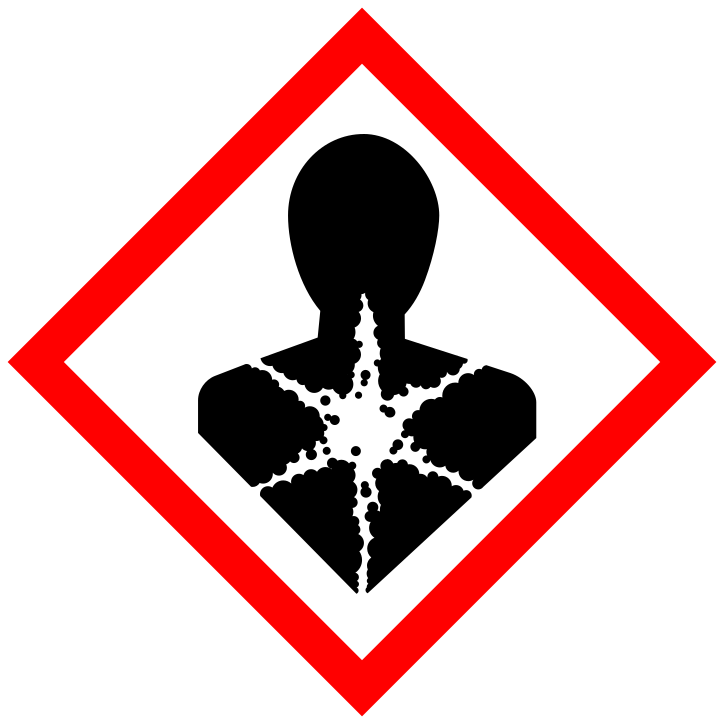
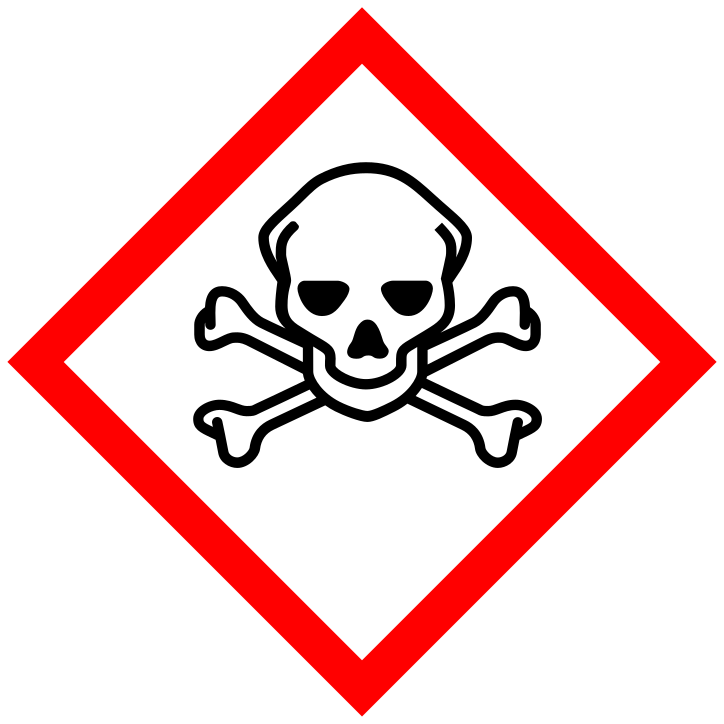
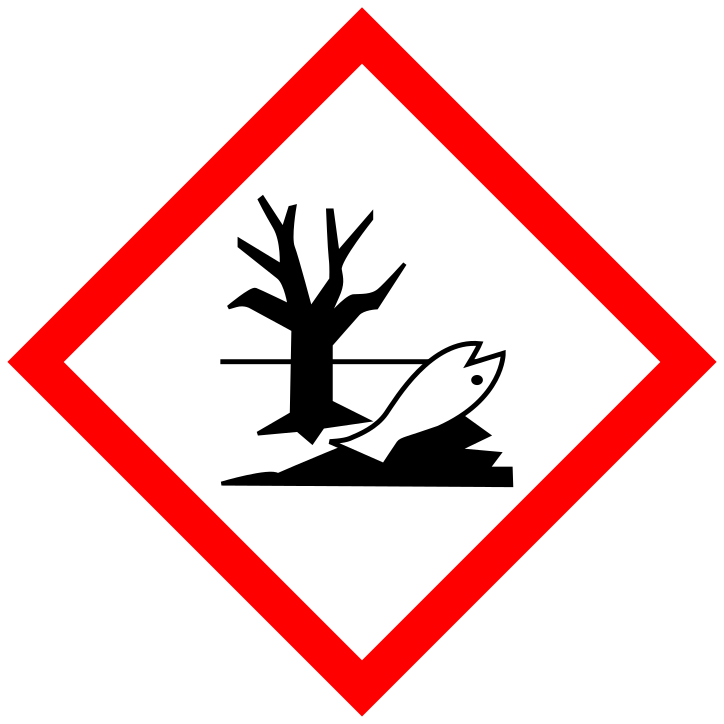
Danger
Phosmet
- Suspected of damaging fertility.
- Toxic if swallowed.
- Harmful if inhaled.
- Causes damage to organs <or state all organs affected, if known> <state route of exposure if it is conclusively proven that no other routes of exposure cause the hazard>.
- Very toxic to aquatic life.
- Very toxic to aquatic life with long lasting effects.
- Do not breathe dust/fume/gas/mist/vapours/spray.
- Do not eat, drink or smoke when using this product.
- Use only outdoors or in a well-ventilated area.
- Avoid release to the environment.
- IF SWALLOWED:
- IF INHALED:
- IF exposed or concerned:
- Immediately call a POISON CENTER/doctor/…
- Call a POISON CENTER/doctor/…
- Call a POISON CENTER/doctor/… if you feel unwell.
- Rinse mouth.
- Collect spillage.
- Dispose of contents/container to …
Supplier name, address and telephone number· Product identifier·Nominal quantity
Need this as an actual label? Open Phosmet in the GHS label constructor →
07 · Health hazards
Phosmet health hazards and exposure limits
Phosmet hazard summary
A cholinesterase inhibitor that may cause CNS effects resulting in convulsions and respiratory depression; Can be absorbed through skin; [ICSC] Highly toxic cholinesterase inhibitor; [CAMEO] A man who attempted suicide by ingestion was brought by friend to emergency room with symptoms including oral and bronchial secretions and respiratory distress requiring intubation; Within an hour health care personal began developing symptoms of poisoning; A nursing assistant who had contact with the patients skin and bodily fluids required intubation and was hospitalized for 9 days; Two nurses who were exposed only by inhalation in close proximity to the patient developed symptoms including confusion, nausea, abdominal cramps, and dyspnea; Many poisoning cases have been reported from the use of animal dips and shampoos by pet owners, groomers, and veterinary assistants; [HSDB] Not likely to be teratogenic, based on animal studies; [REPROTOX] The average of two baseline respective cholinesterase activity determinations three days apart, with no exposures to enzyme inhibiting pesticides for at least 30 days, is recommended for each worker prior to exposure to cholinesterase inhibitors because of large inter-individual differences in published baseline values. To be established at least once a year. Removal from workplace exposures is recommended until the cholinesterase activity returns to within 20% of baseline. [TLVs and BEIs]
Source: Haz-Map, Information on Hazardous Chemicals and Occupational Diseases
Phosmet carcinogenicity classification
Cancer Classification: Suggestive Evidence of Carcinogenicity, but Not Sufficient to Assess Human Carcinogenic Potential
Source: Hazardous Substances Data Bank (HSDB)
An IARC group and a CLP classification answer different questions. IARC judges whether the evidence for cancer in humans is strong enough; CLP Annex VI is the legally binding EU classification. A substance can carry one and not the other.
08 · Physical and chemical properties
Phosmet properties
Every value is shown with the conditions it was measured under and the source it came from. Where sources disagree, all values are listed rather than one being picked — the difference is usually a different form of the substance, not an error.
Phosmet boiling point
| Property | Value | Conditions | Source |
|---|---|---|---|
| Boiling point | Decomposes below boiling point (EPA, 1998) | decomposes | CAMEO |
Phosmet melting point
| Property | Value | Conditions | Source |
|---|---|---|---|
| Melting point | 71.67 °C (161 °F) | CAMEO | |
| 72 °C (161.6 °F) | ICSC | ||
| 71.9 °C (161.4 °F) | DOE PAC |
Phosmet density
| Property | Value | Conditions | Source |
|---|---|---|---|
| Density | 1.03 g/cm³ | ICSC | |
| 1.03 g/cm³ | at 20 °C | HSDB |
Phosmet solubility
| Property | Value | Conditions | Source |
|---|---|---|---|
| Solubility | 100 G/KG IN DICHLOROMETHANE, 4-METHYLPENT-3-EN-2-ONE, BUTANONE | HSDB | |
| In water, 24.4 mg/L at 20 °C | at 20 °C | HSDB | |
| At 25 °C: 25 mg/L water; 650 g/L acetone; 600 g/L benzene; 5 g/L kerosene; 50 g/L methanol; 300 g/L toluene, methyl isobutyl ketone; 250 g/L xylene. | at 25 °C | HSDB |
Phosmet vapor pressure
| Property | Value | Conditions | Source |
|---|---|---|---|
| Vapor pressure | 4.9e-7 mmHg | HSDB | |
| 0.00054 mmHg | at 25 °C | DOE PAC | |
| 0.001 mmHg | at 50 °C | CAMEO |
Phosmet lower explosive limit (LEL)
| Property | Value | Conditions | Source |
|---|---|---|---|
| Lower explosive limit (LEL) | Containers may explode in the heat of fire. | HSDB |
Phosmet corrosivity
| Property | Value | Conditions | Source |
|---|---|---|---|
| Corrosivity | SLIGHTLY CORROSIVE TO METALS | HSDB |
Values compiled from PubChem Laboratory Chemical Safety Summary. Temperatures converted to Fahrenheit for reference.
09 · Fire and explosion
Phosmet fire and explosion behaviour
These are descriptions rather than measured values, so they are kept out of the table above and quoted here with the source that reported them.
Phosmet fire potential
This material may burn but does not ignite readily. /Organophosphorus pesticide NOS/
Source: Hazardous Substances Data Bank (HSDB)
10 · Handling and storage
Phosmet storage and handling
Phosmet safe storage
Provision to contain effluent from fire extinguishing. Separated from food and feedstuffs.
Source: ILO-WHO International Chemical Safety Cards (ICSCs)
Phosmet storage conditions
Store in tightly closed containers in a cool, well vented area away form other pesticide, alkaline conditions, water and other forms of moisture. Where possible, automatically transfer material from drums or other storage containers to process containers. Sources of ignition such as smoking and open flames are prohibited where this chemical is handled, used, or stored. Metal containers involving the transfer of this chemical should be grounded and bonded. Whenever this chemical is used, handled, manufactured, or stored, use explosion-proof electrical equipment and fittings.
Source: Hazardous Substances Data Bank (HSDB)
Phosmet incompatible materials
Not compatible with other pesticides under alkaline conditions. Contact with water, steam or moisture forms phthalic acids. Slightly corrosive to metals in the presence of moisture.
Source: Hazardous Substances Data Bank (HSDB)
Phosmet reactivity
Organophosphates, such as PHOSMET, are susceptible to formation of highly toxic and flammable phosphine gas in the presence of strong reducing agents such as hydrides. Partial oxidation by oxidizing agents may result in the release of toxic phosphorus oxides. Storage above 113 F, may lead to decomposition. [EPA, 1998].
Source: CAMEO Chemicals
Planning storage for a mix of chemicals? Check Phosmet in the storage compatibility matrix →
11 · Questions
Phosmet — frequently asked questions
What is the CAS number of Phosmet?
The CAS number of Phosmet is 732-11-6. Its EC number is 211-987-4.
What is the chemical formula of Phosmet?
The molecular formula of Phosmet is C11H12NO4PS2 and its molecular weight is 317.3 g/mol.
What does a Phosmet label have to show?
Under CLP Annex VI the label for Phosmet carries the pictograms Health hazard, Skull and crossbones and Environment and the signal word is Danger.
Is Phosmet flammable?
CLP Annex VI assigns Phosmet no flammability hazard class. That is not a statement that it cannot burn: the harmonised list only records the hazards that were assessed for it.
Is Phosmet a carcinogen?
CLP Annex VI records no harmonised carcinogenicity classification for Phosmet. Annex VI is a list of agreed classifications, not a list of substances found safe, so this is an absence of a classification rather than a clean bill of health.
What is the melting point of Phosmet?
The melting point of Phosmet is 71.9 °C (161 °F), a figure on which EPA via CAMEO, ICSC and DOE PAC agree.
How should Phosmet be stored?
Store in tightly closed containers in a cool, well vented area away form other pesticide, alkaline conditions, water and other forms of moisture. Where possible, automatically transfer material from drums or other storage containers to process containers. Sources of ignition such as smoking and open flames are prohibited where this chemical is handled, used, or stored. Metal containers involving the transfer of this chemical should be grounded and bonded. Whenever this chemical is used, handled, manufactured, or stored, use explosion-proof electrical equipment and fittings. (Hazardous Substances Data Bank (HSDB))
Nearby
Substances next to Phosmet
Keep going: substances starting with P, or search the whole database by name, CAS number, pictogram or signal word.