Substance profile
Phenolphthalein
Phenolphthalein is white or yellowish-white minute, triclinic crystals, often twinned and is odorless.
01 · Identification
What Phenolphthalein is
Phenolphthalein is white or yellowish-white minute, triclinic crystals, often twinned and is odorless. Its molecular formula is C20H14O4 and its molecular weight is 318.3 g/mol. It melts at 263 °C.
Under the GHS it carries the signal word Danger. It is classed as carcinogens.
02 · Identifiers
Phenolphthalein identifiers and molecular data
Phenolphthalein CAS number and EC number
Phenolphthalein molecular formula and molecular weight
03 · GHS classification
Phenolphthalein hazard classification
Harmonised classification under CLP Annex VI. This is the legally binding classification in the EU; other jurisdictions may differ.
Phenolphthalein pictograms and signal word
Phenolphthalein hazard class and category
| Hazard class | Category | From code | Pictogram |
|---|---|---|---|
| Germ cell mutagenicity GHS chapter 3.5 | Category 2 | H341 | GHS08 |
| Carcinogenicity GHS chapter 3.6 | Category 1A or 1B | H350 | GHS08 |
Where two values are shown with “or”, the hazard statement is shared by more than one category or by more than one class, and the code alone does not say which. H272, for example, belongs to oxidising liquids and to oxidising solids — the physical state decides. The binding answer for a specific entry is in the CLP Annex VI table itself.
Phenolphthalein hazard statements (H-codes)
| Code | Hazard statement |
|---|---|
| H350 | May cause cancer <state route of exposure if it is conclusively proven that no other routes of exposure cause the hazard>. |
| H341 | Suspected of causing genetic defects <state route of exposure if it is conclusively proven that no other routes of exposure cause the hazard>. |
| H361f | Suspected of damaging fertility. |
This page lists only the codes assigned to Phenolphthalein. The full reference lives on the hazard statements hub, the precautionary statements hub and the GHS pictograms hub.
Safety Data Sheet
Getting an SDS for Phenolphthalein
A Safety Data Sheet is written for a product, not for a substance: the supplier of the grade you actually buy issues it, so two suppliers of Phenolphthalein issue two different sheets. That is why there is no single authoritative SDS for a substance to download — what there is, is the job of collecting the sheets for the products you hold and keeping them current as suppliers revise them.
04 · Precautionary statements
Phenolphthalein precautionary statements
CLP Annex VI assigns 4 precautionary statements to Phenolphthalein. They are grouped the way a label groups them: what to do before handling, what to do when something has already happened, how to store it and how to dispose of it.
Prevention
What to do before and during handling so the hazard never happens.
Response
What to do once exposure, spillage or fire has already happened.
Reading the notation. … is a blank the supplier fills in — not a truncated sentence.· [square brackets] mark a part printed only when it applies.
05 · Names in the regulation
Phenolphthalein name in 23 EU languages
CLP Annex VI Part 3 is published in every language edition of the regulation, and the identification column is written out in each of them. Nothing below is translated by us: each line is the name as that edition prints it. Under Art. 18(2) the substance name from Annex VI is a lawful product identifier, so this is the wording to put on a label going to that market — and where the cell lists several designations, any one of them qualifies.
| Language | Name in CLP Annex VI Part 3 |
|---|---|
| Bulgarian български | фенолфталеин |
| Spanish español | Fenolftaleína |
| Czech čeština | fenolftalein |
| Danish dansk | phenolphthalein |
| German Deutsch | Phenolphthalein |
| Estonian eesti | fenoolftaleiin |
| Greek ελληνικά | φαινολοφθαλεΐνη |
| English English | phenolphthalein |
| French français | phénolphtaléine |
| Croatian hrvatski | fenolftalein |
| Italian italiano | fenolftaleina |
| Latvian latviešu | fenolftaleīns |
| Lithuanian lietuvių | fenolftaleinas |
| Hungarian magyar | fenolftalein |
| Maltese Malti | fenolftalein |
| Dutch Nederlands | fenolftaleïne |
| Polish polski | fenoloftaleina |
| Portuguese português | fenolftaleína |
| Romanian română | fenolftaleină |
| Slovak slovenčina | fenolftaleín |
| Slovenian slovenščina | fenolftalein |
| Finnish suomi | fenoliftaleiini |
| Swedish svenska | fenolftalein |
All 23 language editions of Annex VI carry this entry. Irish is the twenty-fourth official EU language and has no line here for a different reason: no consolidated CLP text has ever been published in Irish, so there is no Irish edition of Annex VI to quote a name from. Source: consolidated CLP, CELEX 02008R1272, language editions. © European Union, https://eur-lex.europa.eu — only the electronic Official Journal of the European Union is authentic.
06 · Label elements
Phenolphthalein GHS label elements
Everything CLP Annex VI fixes for Phenolphthalein, laid out the way it appears on a label. The greyed lines are the parts only the supplier can fill in.
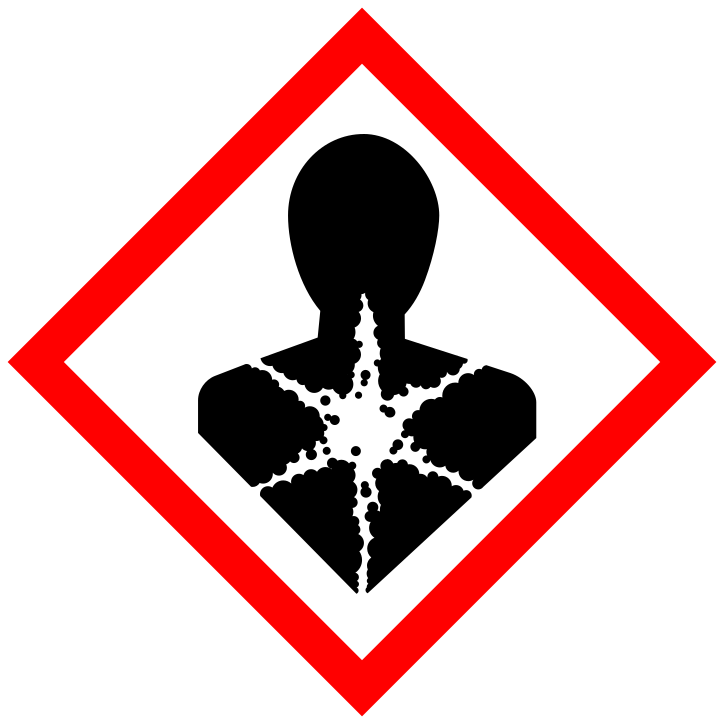
Danger
Phenolphthalein
- May cause cancer <state route of exposure if it is conclusively proven that no other routes of exposure cause the hazard>.
- Suspected of causing genetic defects <state route of exposure if it is conclusively proven that no other routes of exposure cause the hazard>.
- Suspected of damaging fertility.
- Obtain special instructions before use.
- Wear protective gloves/protective clothing/eye protection/face protection/hearing protection/…
- IF exposed or concerned:
- Get medical advice/attention.
Supplier name, address and telephone number· Product identifier·Nominal quantity
Need this as an actual label? Open Phenolphthalein in the GHS label constructor →
07 · Health hazards
Phenolphthalein health hazards and exposure limits
Phenolphthalein hazard summary
Reported health effects include itching rash after skin contact and purging and collapse after ingestion; [CAMEO] Dust may be irritating if inhaled, but probably not irritating to the skin; [CHEMINFO]
Source: Haz-Map, Information on Hazardous Chemicals and Occupational Diseases
Phenolphthalein carcinogenicity classification
Under the conditions of these 2-year feed studies, there was clear evidence of carcinogenic activity of phenolphthalein in male F344/N rats based on markedly increased incidences of benign pheochromocytomas of the adrenal medulla and of renal tubule adenomas and adenomas or carcinomas (combined). There was some evidence of carcinogenic activity of phenolphthalein in female F344/N rats based on the increased incidences of benign pheochromocytomas of the adrenal medulla in the 12,000 ppm group and of benign or malignant pheochromocytomas (combined) in the 12,000 and 25,000 ppm groups. There was clear evidence of carcinogenic activity of phenolphthalein in male B6C3F1 mice based on increased incidences of histiocytic sarcomas and of malignant lymphomas of thymic origin. There was clear evidence of carcinogenic activity of phenolphthalein in female B6C3F1 mice based on increased incidences of histiocytic sarcomas, malignant lymphomas of all types, lymphomas of thymic origin, and benign sex-cord stromal tumors of the ovary.
Source: US National Toxicology Program · TR-465: Toxicology and Carcinogenesis Studies of Phenolphthalein (CASRN 77-09-8) in F344/N Rats and B6C3F1 Mice (Feed Studies) (1996 )
Evaluation: There is inadequate evidence in humans for the carcinogenicity of phenolphthalein. There is sufficient evidence in experimental animals for the carcinogenicity of phenolphthalein. Overall evaluation: Phenolphthalein is possibly carcinogenic to humans (Group 2B)
Source: Hazardous Substances Data Bank (HSDB)
Phenolphthalein: reasonably anticipated to be a human carcinogen.
Source: Hazardous Substances Data Bank (HSDB)
An IARC group and a CLP classification answer different questions. IARC judges whether the evidence for cancer in humans is strong enough; CLP Annex VI is the legally binding EU classification. A substance can carry one and not the other.
08 · Physical and chemical properties
Phenolphthalein properties
Every value is shown with the conditions it was measured under and the source it came from. Where sources disagree, all values are listed rather than one being picked — the difference is usually a different form of the substance, not an error.
Phenolphthalein melting point
| Property | Value | Conditions | Source |
|---|---|---|---|
| Melting point | 262.5 °C (504.5 °F) | HSDB | |
| 260 °C (500 °F) | range, midpoint shown | CAMEO |
Phenolphthalein density
| Property | Value | Conditions | Source |
|---|---|---|---|
| Density | 1.299 g/cm³ | at 25 °C | CAMEO |
| 1.277 g/cm³ | at 32 °C | HSDB |
Phenolphthalein solubility
| Property | Value | Conditions | Source |
|---|---|---|---|
| Solubility | 1 g dissolves in 12 ml alcohol, in about 100 ml ether; sol in dil solutions of Alkali hydroxides and hot solutions of alkali carborates forming a red soln | HSDB | |
| In water, 400 mg/L @ room temperature | HSDB |
Phenolphthalein vapor pressure
| Property | Value | Conditions | Source |
|---|---|---|---|
| Vapor pressure | 6.7e-13 mmHg | at 25 °C | HSDB |
Values compiled from PubChem Laboratory Chemical Safety Summary. Temperatures converted to Fahrenheit for reference.
09 · Source notes
Further notes on Phenolphthalein
These are descriptions rather than measured values, so they are kept out of the table above and quoted here with the source that reported them.
Solubility
Insoluble in benzene and petroleum ether; slightly soluble in carbon disulfide; soluble in ethyl ether, chloroform, and toluene; very soluble in ethanol, acetone, and pyrene.
Source: HSDB
10 · Handling and storage
Phenolphthalein storage and handling
Phenolphthalein storage conditions
PRECAUTIONS FOR "CARCINOGENS": Storage site should be as close as practical to lab in which carcinogens are to be used, so that only small quantities required for ... expt need to be carried. Carcinogens should be kept in only one section of cupboard, an explosion-proof refrigerator or freezer (depending on chemicophysical properties ...) that bears appropriate label. An inventory ... should be kept, showing quantity of carcinogen & date it was acquired ... Facilities for dispensing ... should be contiguous to storage area. /Chemical Carcinogens/
Source: Hazardous Substances Data Bank (HSDB)
Phenolphthalein reactivity
PHENOLPHTHALEIN is incompatible with alkaloids. (NTP, 1992)
Source: CAMEO Chemicals
Planning storage for a mix of chemicals? Check Phenolphthalein in the storage compatibility matrix →
11 · Questions
Phenolphthalein — frequently asked questions
What is the CAS number of Phenolphthalein?
The CAS number of Phenolphthalein is 77-09-8. Its EC number is 201-004-7.
What is the chemical formula of Phenolphthalein?
The molecular formula of Phenolphthalein is C20H14O4 and its molecular weight is 318.3 g/mol.
What does a Phenolphthalein label have to show?
Under CLP Annex VI the label for Phenolphthalein carries the pictogram Health hazard and the signal word is Danger.
Is Phenolphthalein flammable?
CLP Annex VI assigns Phenolphthalein no flammability hazard class. That is not a statement that it cannot burn: the harmonised list only records the hazards that were assessed for it.
Is Phenolphthalein a carcinogen?
Yes. CLP Annex VI classifies Phenolphthalein as a category 1A or 1B carcinogen and assigns it H350: may cause cancer. IARC places it in Group 2B: possibly carcinogenic to humans.
What is the melting point of Phenolphthalein?
The melting point of Phenolphthalein is 263 °C (505 °F), a figure on which HSDB, NTP via CAMEO and DrugBank agree.
How should Phenolphthalein be stored?
PRECAUTIONS FOR "CARCINOGENS": Storage site should be as close as practical to lab in which carcinogens are to be used, so that only small quantities required for ... expt need to be carried. Carcinogens should be kept in only one section of cupboard, an explosion-proof refrigerator or freezer (depending on chemicophysical properties ...) that bears appropriate label. An inventory ... should be kept, showing quantity of carcinogen & date it was acquired ... Facilities for dispensing ... should be contiguous to storage area. /Chemical Carcinogens/ (Hazardous Substances Data Bank (HSDB))
Nearby
Substances next to Phenolphthalein
Keep going: substances starting with P, or search the whole database by name, CAS number, pictogram or signal word.