Substance profile
Cobalt
Cobalt is a gray metal, hexagonal or cubic and is odorless.
01 · Identification
What Cobalt is
Cobalt is a gray metal, hexagonal or cubic and is odorless. It melts at 1495 °C, is soluble in water.
Under the GHS it carries the signal word Danger. It is classed as hazardous Air Pollutants (HAPs).
02 · Identifiers
Cobalt identifiers and molecular data
Cobalt CAS number and EC number
Cobalt molecular formula and molecular weight
Other names for Cobalt
- Aco 4
- Aquacat
- C.I. 77320
- Co 0138E
- Cobalt Element
- Cobalt Fulleride (Coc20)
- Cobalt Metal Dust
- Cobalt Metal Fume
- Cobalt-59
- Super Cobalt
03 · GHS classification
Cobalt hazard classification
Harmonised classification under CLP Annex VI. This is the legally binding classification in the EU; other jurisdictions may differ.
Cobalt pictograms and signal word
Cobalt hazard class and category
| Hazard class | Category | From code | Pictogram |
|---|---|---|---|
| Respiratory sensitisation GHS chapter 3.4 | Category 1 or 1A or 1B | H334 | GHS08 |
| Skin sensitisation GHS chapter 3.4 | Category 1 or 1A or 1B | H317 | GHS07 |
| Germ cell mutagenicity GHS chapter 3.5 | Category 2 | H341 | GHS08 |
| Carcinogenicity GHS chapter 3.6 | Category 1A or 1B | H350 | GHS08 |
| Hazardous to the aquatic environment - chronic GHS chapter 4.1 | Category 4 | H413 | — |
Where two values are shown with “or”, the hazard statement is shared by more than one category or by more than one class, and the code alone does not say which. H272, for example, belongs to oxidising liquids and to oxidising solids — the physical state decides. The binding answer for a specific entry is in the CLP Annex VI table itself.
Cobalt hazard statements (H-codes)
| Code | Hazard statement |
|---|---|
| H350 | May cause cancer <state route of exposure if it is conclusively proven that no other routes of exposure cause the hazard>. |
| H341 | Suspected of causing genetic defects <state route of exposure if it is conclusively proven that no other routes of exposure cause the hazard>. |
| H360F | May damage fertility. |
| H334 | May cause allergy or asthma symptoms or breathing difficulties if inhaled. |
| H317 | May cause an allergic skin reaction. |
| H413 | May cause long lasting harmful effects to aquatic life. |
This page lists only the codes assigned to Cobalt. The full reference lives on the hazard statements hub, the precautionary statements hub and the GHS pictograms hub.
Safety Data Sheet
Getting an SDS for Cobalt
Our own Cobalt safety data sheet walks through all sixteen sections of the published data. What it is not is the document an inspector asks for: an SDS is issued for a product by its supplier, so the sheet covering the grade actually standing in your store exists only in that supplier’s version. Collecting those and keeping them current as suppliers revise them is a separate job.
04 · Precautionary statements
Cobalt precautionary statements
CLP Annex VI assigns 9 precautionary statements to Cobalt. They are grouped the way a label groups them: what to do before handling, what to do when something has already happened, how to store it and how to dispose of it.
Prevention
What to do before and during handling so the hazard never happens.
Response
What to do once exposure, spillage or fire has already happened.
Disposal
What has to happen to the contents and the empty container.
Reading the notation. … is a blank the supplier fills in — not a truncated sentence.· [square brackets] mark a part printed only when it applies.
05 · Names in the regulation
Cobalt name in 23 EU languages
CLP Annex VI Part 3 is published in every language edition of the regulation, and the identification column is written out in each of them. Nothing below is translated by us: each line is the name as that edition prints it. Under Art. 18(2) the substance name from Annex VI is a lawful product identifier, so this is the wording to put on a label going to that market — and where the cell lists several designations, any one of them qualifies.
| Language | Name in CLP Annex VI Part 3 |
|---|---|
| Bulgarian български | кобалт |
| Spanish español | Cobalto |
| Czech čeština | kobalt |
| Danish dansk | Kobalt |
| German Deutsch | Cobalt |
| Estonian eesti | koobalt |
| Greek ελληνικά | κοβάλτιο |
| English English | cobalt |
| French français | cobalt |
| Croatian hrvatski | kobalt |
| Italian italiano | cobalto |
| Latvian latviešu | kobalts |
| Lithuanian lietuvių | kobaltas |
| Hungarian magyar | kobalt |
| Maltese Malti | kobalt |
| Dutch Nederlands | kobalt |
| Polish polski | kobalt |
| Portuguese português | cobalto |
| Romanian română | cobalt |
| Slovak slovenčina | kobalt |
| Slovenian slovenščina | kobalt |
| Finnish suomi | Koboltti |
| Swedish svenska | kobolt |
All 23 language editions of Annex VI carry this entry. Irish is the twenty-fourth official EU language and has no line here for a different reason: no consolidated CLP text has ever been published in Irish, so there is no Irish edition of Annex VI to quote a name from. Source: consolidated CLP, CELEX 02008R1272, language editions. © European Union, https://eur-lex.europa.eu — only the electronic Official Journal of the European Union is authentic.
06 · Label elements
Cobalt GHS label elements
Everything CLP Annex VI fixes for Cobalt, laid out the way it appears on a label. The greyed lines are the parts only the supplier can fill in.
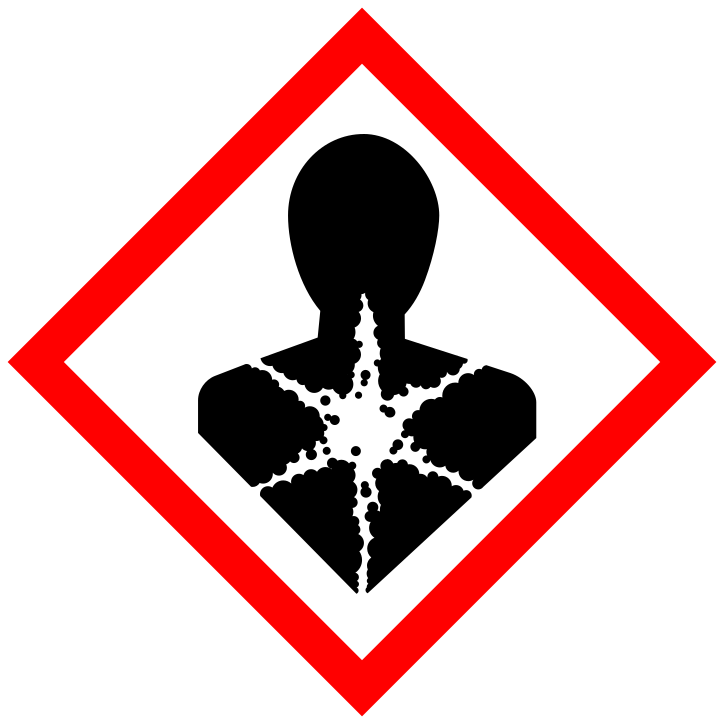
Danger
Cobalt
- May cause cancer <state route of exposure if it is conclusively proven that no other routes of exposure cause the hazard>.
- Suspected of causing genetic defects <state route of exposure if it is conclusively proven that no other routes of exposure cause the hazard>.
- May damage fertility.
- May cause allergy or asthma symptoms or breathing difficulties if inhaled.
- May cause an allergic skin reaction.
- May cause long lasting harmful effects to aquatic life.
- Obtain special instructions before use.
- Avoid breathing dust/fume/gas/mist/vapours/spray.
- Contaminated work clothing should not be allowed out of the workplace.
- Avoid release to the environment.
- Wear protective gloves/protective clothing/eye protection/face protection/hearing protection/…
- IF exposed or concerned:
- Get medical advice/attention.
- If skin irritation or rash occurs:
- Dispose of contents/container to …
Supplier name, address and telephone number· Product identifier·Nominal quantity
Need this as an actual label? Open Cobalt in the GHS label constructor →
07 · Health hazards
Cobalt health hazards and exposure limits
Cobalt hazard summary
Cobalt is a naturally occurring element found in rocks, soil, water, plants, and animals. Cobalt is used to produce alloys used in the manufacture of aircraft engines, magnets, grinding and cutting tools, artificial hip and knee joints. Cobalt compounds are also used to color glass, ceramics and paints, and used as a drier for porcelain enamel and paints. Radioactive cobalt is used for commercial and medical purposes.60Co (read as cobalt sixty) is used for sterilizing medical equipment and consumer products, radiation therapy for treating cancer patients, manufacturing plastics, and irradiating food.57Co is used in medical and scientific research. It takes about 5.27 years for half of60Co to give off its radiation and about 272 days for57Co; this is called the half-life.
Source: Agency for Toxic Substances and Disease Registry (ATSDR)
Cobalt carcinogenicity classification
Under the conditions of these 2-year inhalation studies, there was clear evidence of carcinogenic activity of cobalt metal in male F344/NTac rats based on increased incidences of alveolar/bronchiolar adenoma and carcinoma in the lung, including multiples, and on increased incidences of benign and malignant pheochromocytoma of the adrenal medulla, including bilateral neoplasms (a summary of the Peer Review Panel comments and the public discussion on this Technical Report appears in Appendix O). The increased incidences of pancreatic islet adenoma or carcinoma (combined) were considered related to exposure. The occurrences of cystic keratinizing epithelioma of the lung and of renal tubule adenoma or carcinoma (combined) may have been related to exposure. There was clear evidence of carcinogenic activity of cobalt metal in female F344/NTac rats based on increased incidences of alveolar/bronchiolar adenoma and carcinoma in the lung, including multiples, and on increased incidences of benign and malignant pheochromocytoma of the adrenal medulla, including bilateral neoplasms. The occurrences of squamous cell neoplasms of the lung (predominantly cystic keratinizing epithelioma), and of mononuclear cell leukemia were considered related to exposure. The occurrences of pancreatic islet carcinoma may have been related to exposure. There was clear evidence of carcinogenic activity of cobalt metal in male and female B6C3F1/N mice based on increased incidences of alveolar/bronchiolar neoplasms of the lung (predominantly carcinoma), including multiple carcinoma.
Source: US National Toxicology Program · TR-581: Toxicology Studies of Cobalt Metal (CASRN 7440-48-4) in F344/N Rats and B6C3F1/N Mice and Toxicology and Carcinogenesis Studies of Cobalt Metal in F344/NTac Rats and B6C3F1/N Mice (Inhalation Studies) (2014 )
There is inadequate evidence for the carcinogenicity of cobalt and cobalt compounds in humans. There is sufficient evidence for the carcinogenicity of cobalt metal powder in experimental animals. There is limited evidence for the carcinogenicity of metal alloys containing cobalt, chromium and molybdenum in experimental animals. ... Overall Evaluation: Cobalt and cobalt compounds are possibly carcinogenic to humans (Group 2B). /Cobalt and cobalt compounds/
Source: Hazardous Substances Data Bank (HSDB)
Cobalt and cobalt compounds that release cobalt ions in vivo are reasonably anticipated to be human carcinogens based on sufficient evidence of carcinogenicity from studies in experimental animals and supporting data from studies on mechanisms of carcinogenesis. /Cobalt and cobalt compounds/
Source: Hazardous Substances Data Bank (HSDB)
An IARC group and a CLP classification answer different questions. IARC judges whether the evidence for cancer in humans is strong enough; CLP Annex VI is the legally binding EU classification. A substance can carry one and not the other.
Cobalt occupational exposure limits
| Limit | Value | Source |
|---|---|---|
| PEL | 0.1 [mg/m3], as Co (metal dust and fume) | Haz-Map, Information on Hazardous Chemicals and Occupational Diseases |
| PEL | 0.1 mg/m³ | Occupational Safety and Health Administration (OSHA) |
| PEL | TWA 0.1 mg/m3 See Appendix G | The National Institute for Occupational Safety and Health (NIOSH) |
| REL | 0.05 mg/m³ | Occupational Safety and Health Administration (OSHA) |
| REL | TWA 0.05 mg/m3 | The National Institute for Occupational Safety and Health (NIOSH) |
| IDLH | 20 mg Co/m3 (NIOSH, 2024) | CAMEO Chemicals |
| IDLH | 20.0 [mg/m3] | Haz-Map, Information on Hazardous Chemicals and Occupational Diseases |
| IDLH | 20 mg/cu m. /Cobalt metal dust and fume (as Co)/ | Hazardous Substances Data Bank (HSDB) |
These are United States values. The European Union sets its own indicative and binding limits, and the figure that applies at a given workplace is the one in the local regulation — not the one shown here.
08 · Physical and chemical properties
Cobalt properties
Every value is shown with the conditions it was measured under and the source it came from. Where sources disagree, all values are listed rather than one being picked — the difference is usually a different form of the substance, not an error.
Cobalt boiling point
| Property | Value | Conditions | Source |
|---|---|---|---|
| Boiling point | 2927 °C (5300.6 °F) | HSDB | |
| 3100 °C (5612 °F) | NIOSH | ||
| 2870 °C (5198 °F) | at 760 mmHg | CAMEO |
Cobalt melting point
| Property | Value | Conditions | Source |
|---|---|---|---|
| Melting point | 1495 °C (2723 °F) | HSDB | |
| 1493 °C (2719 °F) | NIOSH |
Cobalt density
| Property | Value | Conditions | Source |
|---|---|---|---|
| Density | 8.92 g/cm³ | NIOSH | |
| 8.9 g/cm³ | at 20 °C | HSDB |
Cobalt solubility
| Property | Value | Conditions | Source |
|---|---|---|---|
| Solubility | Soluble in dilute acids | HSDB | |
| Readily soluble in dilute nitric acid | HSDB | ||
| Insoluble | NIOSH |
Cobalt vapor pressure
| Property | Value | Conditions | Source |
|---|---|---|---|
| Vapor pressure | 0 mmHg | approx | NIOSH |
| 0 mmHg | at 20 °C | CAMEO |
Cobalt lower explosive limit (LEL)
| Property | Value | Conditions | Source |
|---|---|---|---|
| Lower explosive limit (LEL) | Noncombustible Solid in bulk form, but finely divided dust will burn at high temperatures. | NIOSH |
Values compiled from PubChem Laboratory Chemical Safety Summary. Temperatures converted to Fahrenheit for reference.
09 · Fire and explosion
Cobalt fire and explosion behaviour
These are descriptions rather than measured values, so they are kept out of the table above and quoted here with the source that reported them.
Cobalt fire potential
Only certain forms of cobalt metal are pyrophoric. ... Pyrophoric cobalt is a black powder that burns brilliantly when in contact with oxygen or air.
Source: Hazardous Substances Data Bank (HSDB)
10 · Handling and storage
Cobalt storage and handling
Cobalt reactive group
CAMEO Chemicals places Cobalt in the reactive group Metals, Elemental and Powder, Active. Compatibility with other chemicals is worked out from the group, not from the individual substance — which is why two substances you have never seen react can still be flagged as a pair that must be separated.
A reactive group is a CAMEO Chemicals (US NOAA) grouping, not a GHS hazard class: it has no code, no category and no legal force. It is what the storage compatibility matrix on this site computes from.
Cobalt safe storage
Separated from strong oxidants.
Source: ILO-WHO International Chemical Safety Cards (ICSCs)
Cobalt storage conditions
Keep container tightly closed in a dry and well-ventilated place. Air sensitive. Handle and store under inert gas.
Source: Hazardous Substances Data Bank (HSDB)
Cobalt incompatible materials
Incompatible materials: Oxidizing agents, mineral acids, acetylene, hydrazinium nitrate. Material readily reacts with acids generating flammable and/or explosive hydrogen gas.
Source: Hazardous Substances Data Bank (HSDB)
Cobalt reactivity
Pyrophoric COBALT is a reducing agent. Decomposes acetylene in the cold as the metal becomes incandescent [Mellor 14:513(1946-1947]. Incompatible with oxidizing agents such as ammonium nitrate, bromine pentafluoride, and nitryl fluoride.
Source: CAMEO Chemicals
Planning storage for a mix of chemicals? Check Cobalt in the storage compatibility matrix →
11 · Questions
Cobalt — frequently asked questions
What is the CAS number of Cobalt?
The CAS number of Cobalt is 7440-48-4. Its EC number is 231-158-0.
What does a Cobalt label have to show?
Under CLP Annex VI the label for Cobalt carries the pictogram Health hazard and the signal word is Danger.
Is Cobalt flammable?
CLP Annex VI assigns Cobalt no flammability hazard class. That is not a statement that it cannot burn: the harmonised list only records the hazards that were assessed for it.
Is Cobalt a carcinogen?
Yes. CLP Annex VI classifies Cobalt as a category 1A or 1B carcinogen and assigns it H350: may cause cancer. IARC places it in Group 2A: probably carcinogenic to humans.
What is the exposure limit for Cobalt?
The US occupational exposure limit reported for Cobalt is 0.1 [mg/m3], as Co (metal dust and fume) (Haz-Map, Information on Hazardous Chemicals and Occupational Diseases). Limits differ by country: the EU sets its own indicative and binding values, and the figure that applies at a given workplace is the one in the local regulation.
What is the melting point of Cobalt?
The melting point of Cobalt is 1495 °C (2723 °F), a figure on which HSDB, NIOSH and NTP via CAMEO agree.
How should Cobalt be stored?
Keep container tightly closed in a dry and well-ventilated place. Air sensitive. Handle and store under inert gas. (Hazardous Substances Data Bank (HSDB))
Nearby
Substances next to Cobalt
Keep going: substances starting with C, or search the whole database by name, CAS number, pictogram or signal word.
Next