Transport reference
UN 2789 — Acetic acid, glacial or acetic acid solution, more than 80 % acid, by mass
Table A of ADR 2025 and the 49 CFR 172.101 Hazardous Materials Table for this number, kept side by side and never merged, plus the CLP label elements of the substances that ship under it.
The two tables are never merged. The same UN number can carry a different packing group, a different proper shipping name and entirely different special provisions in each system. Every value below sits under the name of the jurisdiction it comes from.
01 · Two jurisdictions
UN 2789 in ADR 2025 and in 49 CFR 172.101
The two systems differ for this number on 1 of 5 fields. Special provisions are deliberately absent from this comparison: identical code numbers mean different things in the two systems.
| Field | ADR 2025 Table A, Chapter 3.2 | 49 CFR 172.101 eCFR 2026-08-03 |
|---|---|---|
| Proper shipping name | ACETIC ACID, GLACIAL or ACETIC ACID SOLUTION, more than 80 % acid, by mass | Acetic acid, glacial or Acetic acid solution, with more than 80 percent acid, by mass |
| Class or division | 8 | 8 |
| Packing group | II | II |
| Label codes | 8, 3 | 8, 3 |
| Rows in the table | 1 | 1 |
Sources: ADR 2025, Table A of Chapter 3.2 · ECE/TRANS/352 Vol. I (UNECE) · 49 CFR 172.101 Hazardous Materials Table · eCFR, revision 2026-08-03
02 · ADR 2025
UN 2789 in Table A of ADR 2025
One row in Table A of Chapter 3.2. Every value below comes from that row.
| Proper shipping name (3.1.2) | Class | Classification code | PG | Labels | Transport category | Hazard ID |
|---|---|---|---|---|---|---|
| ACETIC ACID, GLACIAL or ACETIC ACID SOLUTION, more than 80 % acid, by mass | 8 | CF1 | II | | 2 | 83 |


Source: ADR 2025, Table A of Chapter 3.2 · ECE/TRANS/352 Vol. I (UNECE). Class 8 is “Corrosive substances” (ADR 2.1.1.1).
Transport category and the 1 000-point exemption
Column (15) of Table A decides whether a load stays under the exemption of ADR 1.1.3.6. Quantities of different categories are added with the multipliers below, and the sum must not exceed 1 000.
| Category | Max total quantity per transport unit | Multiplier in 1.1.3.6.4 | What it means |
|---|---|---|---|
| 2 | 333 | × 3 | Packing group II and the listed classes. |
Source: ADR 2025, 1.1.3.6.3 and 1.1.3.6.4 · ECE/TRANS/352 Vol. I (UNECE).
Not imported and therefore not shown for this number: limited quantities (column 7a), excepted quantities (7b), packing instructions (8), tank codes (10–13) and the tunnel restriction code (15). An empty section is more honest than borrowed text.
03 · United States
UN 2789 in the 49 CFR 172.101 Hazardous Materials Table
One row in the Hazardous Materials Table.
| Symbols (1) | Proper shipping name (2) | Class (3) | PG (5) | Labels (6) | Packaging (8) | Quantity limits (9) | Vessel stowage (10) |
|---|---|---|---|---|---|---|---|
| — | Acetic acid, glacial or Acetic acid solution, with more than 80 percent acid, by mass | 8 | II | | §173.154 · §173.202 · §173.243 | 1 L passenger 30 L cargo | A · 53, 58 |

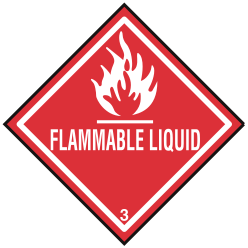
Source: 49 CFR 172.101 Hazardous Materials Table · eCFR, revision 2026-08-03. Class 8 is “Corrosive material” (49 CFR 173.2). Packaging cells are section references into 49 CFR part 173: exceptions, non-bulk, bulk. Handling codes in column 10B are defined in 49 CFR 176.84, which is not part of our import — the numbers are shown as printed in the table.
Vessel stowage categories on this entry
| A | May be stowed “on deck” or “under deck” on a cargo vessel or on a passenger vessel. |
Source: 49 CFR 172.101(k) · eCFR, revision 2026-08-03
Special provisions — 49 CFR 172.102
Codes from column (7) of the Hazardous Materials Table, with the text of § 172.102. These are United States provisions only and have nothing to do with the ADR codes above, even where the number is identical.
| A10 | When aluminum or aluminum alloy construction materials are used, they must be resistant to corrosion. |
| A3 | For combination packagings, if glass inner packagings (including ampoules) are used, they must be packed with absorbent material in tightly closed rigid and leakproof receptacles before packing in outer packagings. |
| A7 | Steel packagings must be corrosion-resistant or have protection against corrosion. |
| B2 | MC 300, MC 301, MC 302, MC 303, MC 305, and MC 306 and DOT 406 cargo tanks are not authorized. |
| IB2 | Authorized IBCs: Metal (31A, 31B and 31N); Rigid plastics (31H1 and 31H2); Composite (31HZ1). |
| T7 | Portable tank instruction. Minimum test pressure: 4 bar; minimum shell thickness (reference steel): § 178.274(d)(2); pressure-relief requirements: Normal; bottom opening requirements: § 178.275(d)(3). See 49 CFR 172.102(c)(7)(ii), Table of Portable Tank T Codes T1-T22. |
| TP2 | a. The maximum degree of filling must not exceed the degree of filling determined by the following: |
Source: 49 CFR 172.102 special provisions · eCFR, revision 2026-08-03
04 · Orange plate
The orange-coloured plate for UN 2789
The upper half of the plate carries the hazard identification number, the lower half the UN number. Dimensions follow ADR 5.3.2.2.1: 400 × 300 mm, black border and dividing line 15 mm, figures 100 mm high.
83 — corrosive or slightly corrosive substance, flammable (flash-point between 23 °C and 60 °C, inclusive).
| 8 | Corrosivity |
| 3 | Flammability of liquids (vapours) and gases or self-heating liquid |
Source: ADR 2025, 5.3.2.3 · ECE/TRANS/352 Vol. II (UNECE). The tunnel restriction code of column (15) is a different value and is not part of our import.
05 · Substances
Substances shipped under UN 2789
Linked by CAS number, never by name: a name match once produced “acetone cyanohydrin” for acetone, and a wrong link here would be a wrong classification. Each entry opens its own reference page with the CLP classification and label elements.
06 · The label side
What UN 2789 looks like on a workplace label
The tables above are the transport classification. This is the other half of the same material: the CLP label elements of the substances linked to this number — what actually goes on the drum once it has been delivered. Transport marks and supply labels answer different regulations and do not replace one another.



Hazard statements on the substances under UN 2789
| H226 | Flammable liquid and vapour. |
| H302 | Harmful if swallowed. |
| H314 | Causes severe skin burns and eye damage. |
| H318 | Causes serious eye damage. |
| H412 | Harmful to aquatic life with long lasting effects. |
Source: harmonised classification, EU CLP Annex VI. Transport classification and supply classification are decided under different rules and do not have to agree.
07 · FAQ
UN 2789 — frequently asked questions
What is UN 2789?
UN 2789 is the United Nations number for Acetic acid, glacial or acetic acid solution, more than 80 % acid, by mass. Under ADR 2025 it is assigned to class 8 (corrosive substances), classification code CF1.
What packing group is UN 2789?
Under ADR 2025 UN 2789 is packing group II.
Is UN 2789 classified the same way in the United States and in Europe?
No. For UN 2789 the two tables differ on proper shipping name. Each panel on this page shows its own source; values from one system must not be carried over into the other.
What is the hazard identification number for UN 2789?
The orange-coloured plate for UN 2789 carries the hazard identification number 83 above the UN number. Under ADR 5.3.2.3.2 that number means: corrosive or slightly corrosive substance, flammable (flash-point between 23 °C and 60 °C, inclusive).
What is the transport category of UN 2789?
Column (15) of Table A puts UN 2789 in transport category 2. Under ADR 1.1.3.6.3 the maximum total quantity per transport unit for that category is 333.
Which substances ship under UN 2789?
We hold 2 substances linked to UN 2789 by CAS number, 1 of which also has a full safety data sheet on this site. Each one has its own reference page with the CLP classification, GHS pictograms and hazard statements that apply on the label — the workplace side of the same material.
Need the plate, the labels or the placards printed?
The orange plate above is a physical article, and so are the class labels in column (5). Our sister site GHSLabels.com covers printing and suppliers. For the workplace label of the same material, use the GHS label constructor, and browse other numbers in the UN number reference.
Reference aid only. Values are reproduced from ADR 2025 and the 49 CFR 172.101 table as published; the consignor remains responsible for the classification of a specific consignment. Always verify against the current published regulation and the supplier's safety data sheet.