Substance profile
Lithium
Lithium is a soft silvery-white metal and is odorless.
01 · Identification
What Lithium is
Lithium is a soft silvery-white metal and is odorless. Its molecular formula is Li and its molecular weight is 7 g/mol. It boils at 1342 °C, melts at 181 °C.
Under the GHS it carries the signal word Danger. It is classed as flammable agents - 2nd degree.
02 · Identifiers
Lithium identifiers and molecular data
Lithium CAS number and EC number
Lithium molecular formula and molecular weight
03 · GHS classification
Lithium hazard classification
Harmonised classification under CLP Annex VI. This is the legally binding classification in the EU; other jurisdictions may differ.
Lithium pictograms and signal word
Lithium hazard class and category
| Hazard class | Category | From code | Pictogram |
|---|---|---|---|
| In contact with water emits flammable gases GHS chapter 2.12 | Category 1 | H260 | GHS02 |
| Skin corrosion/irritation GHS chapter 3.2 | Category 1 or 1A or 1B or 1C | H314 | GHS05 |
Where two values are shown with “or”, the hazard statement is shared by more than one category or by more than one class, and the code alone does not say which. H272, for example, belongs to oxidising liquids and to oxidising solids — the physical state decides. The binding answer for a specific entry is in the CLP Annex VI table itself.
Lithium hazard statements (H-codes)
| Code | Hazard statement |
|---|---|
| H260 | In contact with water releases flammable gases which may ignite spontaneously. |
| H314 | Causes severe skin burns and eye damage. |
Lithium supplemental EU statements (EUH)
| Code | Statement |
|---|---|
| EUH014 | Reacts violently with water. |
This page lists only the codes assigned to Lithium. The full reference lives on the hazard statements hub, the precautionary statements hub and the GHS pictograms hub.
Safety Data Sheet
Getting an SDS for Lithium
A Safety Data Sheet is written for a product, not for a substance: the supplier of the grade you actually buy issues it, so two suppliers of Lithium issue two different sheets. That is why there is no single authoritative SDS for a substance to download — what there is, is the job of collecting the sheets for the products you hold and keeping them current as suppliers revise them.
04 · Precautionary statements
Lithium precautionary statements
CLP Annex VI assigns 5 precautionary statements to Lithium. They are grouped the way a label groups them: what to do before handling, what to do when something has already happened, how to store it and how to dispose of it.
Prevention
What to do before and during handling so the hazard never happens.
Response
What to do once exposure, spillage or fire has already happened.
Reading the notation. … is a blank the supplier fills in — not a truncated sentence.· [square brackets] mark a part printed only when it applies.
05 · Names in the regulation
Lithium name in 23 EU languages
CLP Annex VI Part 3 is published in every language edition of the regulation, and the identification column is written out in each of them. Nothing below is translated by us: each line is the name as that edition prints it. Under Art. 18(2) the substance name from Annex VI is a lawful product identifier, so this is the wording to put on a label going to that market — and where the cell lists several designations, any one of them qualifies.
| Language | Name in CLP Annex VI Part 3 |
|---|---|
| Bulgarian български | литий |
| Spanish español | Litio |
| Czech čeština | lithium |
| Danish dansk | lithium |
| German Deutsch | Lithium |
| Estonian eesti | liitium |
| Greek ελληνικά | λίθιο |
| English English | lithium |
| French français | lithium |
| Croatian hrvatski | litij |
| Italian italiano | litio |
| Latvian latviešu | litijs |
| Lithuanian lietuvių | litis |
| Hungarian magyar | lítium |
| Maltese Malti | litju |
| Dutch Nederlands | lithium |
| Polish polski | lit |
| Portuguese português | lítio |
| Romanian română | litiu |
| Slovak slovenčina | lítium |
| Slovenian slovenščina | litij |
| Finnish suomi | litium |
| Swedish svenska | litium |
All 23 language editions of Annex VI carry this entry. Irish is the twenty-fourth official EU language and has no line here for a different reason: no consolidated CLP text has ever been published in Irish, so there is no Irish edition of Annex VI to quote a name from. Source: consolidated CLP, CELEX 02008R1272, language editions. © European Union, https://eur-lex.europa.eu — only the electronic Official Journal of the European Union is authentic.
06 · Label elements
Lithium GHS label elements
Everything CLP Annex VI fixes for Lithium, laid out the way it appears on a label. The greyed lines are the parts only the supplier can fill in.
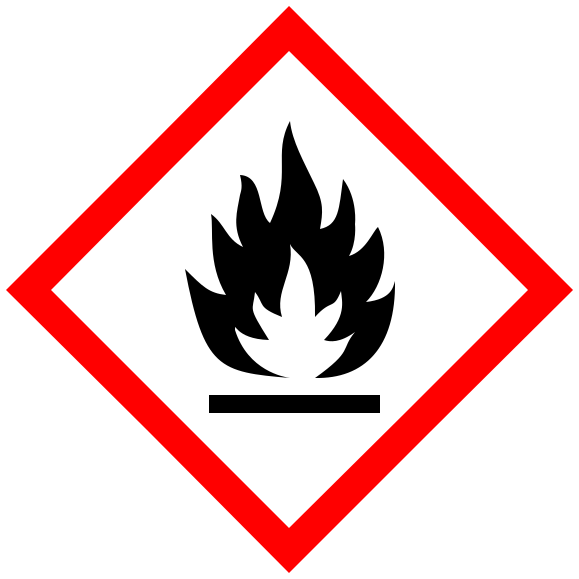
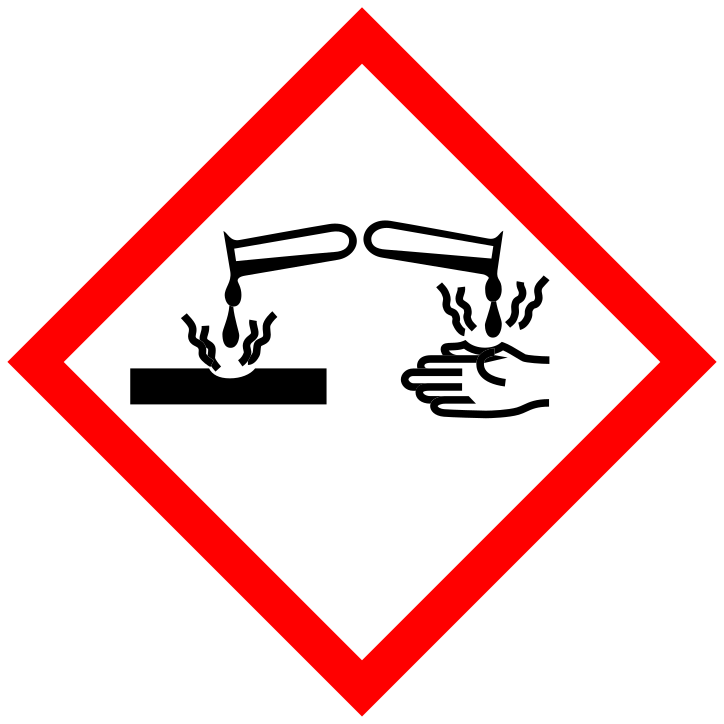
Danger
Lithium
- In contact with water releases flammable gases which may ignite spontaneously.
- Causes severe skin burns and eye damage.
- Reacts violently with water.
- Do not breathe dust/fume/gas/mist/vapours/spray.
- Wear protective gloves/protective clothing/eye protection/face protection/hearing protection/…
- IF SWALLOWED:
- Immediately call a POISON CENTER/doctor/…
- Do NOT induce vomiting.
Supplier name, address and telephone number· Product identifier·Nominal quantity
Need this as an actual label? Open Lithium in the GHS label constructor →
07 · Health hazards
Lithium health hazards and exposure limits
Lithium hazard summary
Reacts with air; Reacts with water to form explosive hydrogen gas and corrosive lithium hydroxide; [CHEMINFO] Lithium poisoning is most common in patients in long-term treatment with renal impairment. The usual daily dose is 300 to 2400 mg. The therapeutic serum level is 0.6-1.2 mEq/L. Lithium intoxication may occur in lithium-treated patients who develop acute gastroenteritis, take thiazide diuretics, or use NSAIDs or ACE inhibitors. Common symptoms of lithium intoxication are lethargy, weakness, slurred speech, ataxia, tremor, and myoclonic jerks which may progress to delirium, seizures, hyperthermia, and coma. Diagnosis is supported by an elevated lithium level, but the degree of elevation does not predict the degree of toxicity. [Olson, p. 293-5] There is evidence from pharmacologic use that lithium is nephrotoxic. [Rosenstock, p. 572] Not being protein bound, Li is rapidly eliminated by the kidneys, with almost no tissue accumulation. Side effects in patients treated with lithium include reduced urinary concentration capacity, hypothyroidism, and neurotoxicity. [Nordberg, p. 969] MAK TWA is for Lithium compounds, inorganic, as Li, except of Li and highly irritating lithium compounds (as lithium amide, hydride, hydroxide, nitride, oxide, tetrahydroalumininate, tetrahydroborate); [MAK]
Source: Haz-Map, Information on Hazardous Chemicals and Occupational Diseases
08 · Physical and chemical properties
Lithium properties
Every value is shown with the conditions it was measured under and the source it came from. Where sources disagree, all values are listed rather than one being picked — the difference is usually a different form of the substance, not an error.
Lithium boiling point
| Property | Value | Conditions | Source |
|---|---|---|---|
| Boiling point | 1342 °C (2447.6 °F) | HSDB | |
| 1336 °C (2436.8 °F) | ICSC | ||
| 1342 °C (2447.6 °F) | at 760 mmHg | DOE PAC |
Lithium melting point
| Property | Value | Conditions | Source |
|---|---|---|---|
| Melting point | 180.54 °C (357 °F) | HSDB | |
| 180.5 °C (356.9 °F) | ICSC | ||
| 25 °C (77 °F) | HSDB |
Lithium density
| Property | Value | Conditions | Source |
|---|---|---|---|
| Density | 0.53 g/cm³ | at 20 °C | CAMEO |
| 0.534 g/cm³ | at 25 °C | HSDB | |
| 0.5 g/cm³ | ICSC |
Lithium solubility
| Property | Value | Conditions | Source |
|---|---|---|---|
| Solubility | Reacts with water | HSDB | |
| Soluble in liquid ammonia forming a blue solution | HSDB | ||
| Solubility in water: violent reaction | ICSC |
Lithium vapor pressure
| Property | Value | Conditions | Source |
|---|---|---|---|
| Vapor pressure | 5.925e-13 mmHg | at 127 °C | HSDB |
| 0.9976 mmHg | at 723 °C | ICSC |
Lithium autoignition temperature
| Property | Value | Conditions | Source |
|---|---|---|---|
| Autoignition temperature | 178.89 °C (354 °F) | CAMEO | |
| 179 °C (354.2 °F) | ICSC |
Lithium critical temperature and pressure
| Property | Value | Conditions | Source |
|---|---|---|---|
| Critical temperature and pressure | 3223 °C (5833.4 °F) | HSDB |
Lithium corrosivity
| Property | Value | Conditions | Source |
|---|---|---|---|
| Corrosivity | LIQUID METAL IS CORROSIVE, ATTACKING GLASS OR PORCELAIN AT A TEMPERATURE OF ABOUT 200 °C | HSDB | |
| Emits corrosive fumes when burned | HSDB |
Values compiled from PubChem Laboratory Chemical Safety Summary. Temperatures converted to Fahrenheit for reference.
09 · Fire and explosion
Lithium fire and explosion behaviour
These are descriptions rather than measured values, so they are kept out of the table above and quoted here with the source that reported them.
Lithium fire potential
... Flammable solid.
Source: Hazardous Substances Data Bank (HSDB)
Fire and explosion
... The powdered metal reacts explosively with water ... Prolonged contact with steam forms a thermally insulating layer which promotes overheating of the metal and may lead to a subsequent explosion as the insulating layer breaks up.
Source: HSDB
... Atmospheric oxidation of molten lithium led to an explosion. A high degree of correlation of incidence of explosions with high atmospheric humidity was demonstrated, with the intensity of explosion apparently directly related to the purity of the sample of metal.
Source: HSDB
10 · Handling and storage
Lithium storage and handling
Lithium safe storage
Fireproof. Separated from strong oxidants, acids, halons and other incompatible materials. See Chemical Dangers. Dry. Keep under mineral oil.
Source: ILO-WHO International Chemical Safety Cards (ICSCs)
Lithium storage conditions
Store in a cool, dry, well-ventilated location. Separate from water.
Source: Hazardous Substances Data Bank (HSDB)
Lithium incompatible materials
Reacts with water forming lithium hydroxide and hydrogen. Keep under mineral oil or other liquid free from oxygen or water.
Source: Hazardous Substances Data Bank (HSDB)
Planning storage for a mix of chemicals? Check Lithium in the storage compatibility matrix →
11 · Transport
Lithium UN number and transport classification
Transport classification is a separate system from the GHS classification above. It decides how a package is marked and how a load may be carried; it does not follow from the workplace label, and the workplace label does not follow from it. The entries below are linked by CAS number, never by name.
Lithium under UN 1415 — shipping name, class and packing group
Europe · ADR 2025, Table A
| Proper shipping name (3.1.2) | Class | Classification code | PG | Labels (column 5) |
|---|---|---|---|---|
| LITHIUM | 4.3 | W2 | I | |

Source: ADR 2025, Table A of Chapter 3.2 · ECE/TRANS/352 Vol. I (UNECE). Class 4.3 is “Substances which, in contact with water, emit flammable gases” (ADR 2.1.1.1).
United States · 49 CFR 172.101 Hazardous Materials Table
| Proper shipping name (column 2) | Class or division | PG | Labels (column 6) |
|---|---|---|---|
| Lithium | 4.3 | I | |
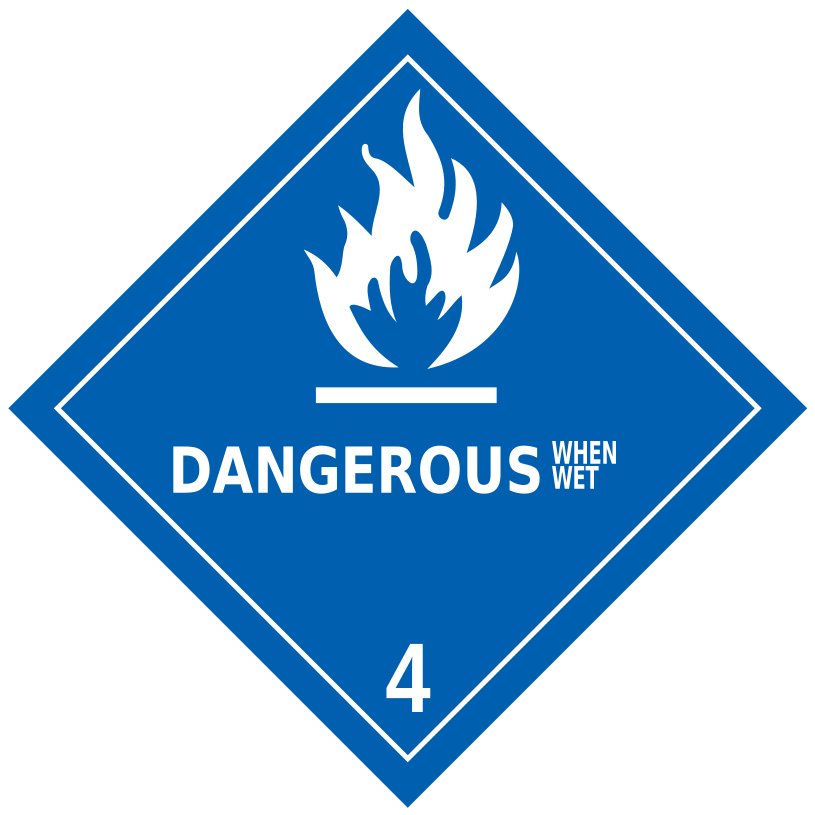
Source: 49 CFR 172.101 Hazardous Materials Table · eCFR, revision 2026-08-03. Class 4.3 is “Dangerous when wet material” (49 CFR 173.2).
12 · Questions
Lithium — frequently asked questions
What is the CAS number of Lithium?
The CAS number of Lithium is 7439-93-2. Its EC number is 231-102-5.
What is the chemical formula of Lithium?
The molecular formula of Lithium is Li and its molecular weight is 7 g/mol.
What does a Lithium label have to show?
Under CLP Annex VI the label for Lithium carries the pictograms Flame and Corrosion and the signal word is Danger.
Is Lithium flammable?
Yes. CLP Annex VI assigns Lithium H260 — in contact with water releases flammable gases which may ignite spontaneously.
Is Lithium a carcinogen?
CLP Annex VI records no harmonised carcinogenicity classification for Lithium. Annex VI is a list of agreed classifications, not a list of substances found safe, so this is an absence of a classification rather than a clean bill of health.
What is the boiling point of Lithium?
The boiling point of Lithium is 1342 °C (2448 °F), a figure on which HSDB, ICSC and DOE PAC agree.
What is the melting point of Lithium?
The melting point of Lithium is 181 °C (357 °F), a figure on which HSDB and ICSC agree.
How should Lithium be stored?
Store in a cool, dry, well-ventilated location. Separate from water. (Hazardous Substances Data Bank (HSDB))
Nearby
Substances next to Lithium
Keep going: substances starting with L, or search the whole database by name, CAS number, pictogram or signal word.