Substance profile
Acetylene
Acetylene is a colorless gas with a not unpleasant odor unless impure (due to phosphine).
01 · Identification
What Acetylene is
Acetylene is a colorless gas with a not unpleasant odor unless impure (due to phosphine). Its molecular formula is C2H2 and its molecular weight is 26.04 g/mol. It boils at -83.9 °C, melts at -80.7 °C.
Under the GHS it carries the signal word Danger. It is classed as flammable agents - 4th degree.
02 · Identifiers
Acetylene identifiers and molecular data
Acetylene CAS number and EC number
Acetylene molecular formula and molecular weight
Other names for Acetylene
- ethyne
- C2H2
- Ethine
- Narcylen
- Vinylene
03 · GHS classification
Acetylene hazard classification
Harmonised classification under CLP Annex VI. This is the legally binding classification in the EU; other jurisdictions may differ.
Acetylene pictograms and signal word
Acetylene hazard class and category
| Hazard class | Category | From code | Pictogram |
|---|---|---|---|
| Flammable gases GHS chapter 2.2 | Category 1A | H220 | GHS02 |
Acetylene hazard statements (H-codes)
| Code | Hazard statement |
|---|---|
| H220 | Extremely flammable gas. |
This page lists only the codes assigned to Acetylene. The full reference lives on the hazard statements hub, the precautionary statements hub and the GHS pictograms hub.
Safety Data Sheet
Getting an SDS for Acetylene
Our own Acetylene safety data sheet walks through all sixteen sections of the published data. What it is not is the document an inspector asks for: an SDS is issued for a product by its supplier, so the sheet covering the grade actually standing in your store exists only in that supplier’s version. Collecting those and keeping them current as suppliers revise them is a separate job.
04 · Precautionary statements
Acetylene precautionary statements
CLP Annex VI assigns 3 precautionary statements to Acetylene. They are grouped the way a label groups them: what to do before handling, what to do when something has already happened, how to store it and how to dispose of it.
Prevention
What to do before and during handling so the hazard never happens.
Reading the notation. … is a blank the supplier fills in — not a truncated sentence.· [square brackets] mark a part printed only when it applies.
05 · Names in the regulation
Acetylene name in 23 EU languages
CLP Annex VI Part 3 is published in every language edition of the regulation, and the identification column is written out in each of them. Nothing below is translated by us: each line is the name as that edition prints it. Under Art. 18(2) the substance name from Annex VI is a lawful product identifier, so this is the wording to put on a label going to that market — and where the cell lists several designations, any one of them qualifies.
| Language | Name in CLP Annex VI Part 3 |
|---|---|
| Bulgarian български | acetylene ethyne |
| Spanish español | acetylene ethyne |
| Czech čeština | acetylene ethyne |
| Danish dansk | acetylene ethyne |
| German Deutsch | acetylene ethyne |
| Estonian eesti | acetylene ethyne |
| Greek ελληνικά | acetylene ethyne |
| English English | acetylene ethyne |
| French français | acetylene ethyne |
| Croatian hrvatski | acetylene ethyne |
| Italian italiano | acetylene ethyne |
| Latvian latviešu | acetylene ethyne |
| Lithuanian lietuvių | acetylene ethyne |
| Hungarian magyar | acetylene ethyne |
| Maltese Malti | acetylene ethyne |
| Dutch Nederlands | acetylene ethyne |
| Polish polski | acetylene ethyne |
| Portuguese português | acetylene ethyne |
| Romanian română | acetylene ethyne |
| Slovak slovenčina | acetylene ethyne |
| Slovenian slovenščina | acetylene ethyne |
| Finnish suomi | acetylene ethyne |
| Swedish svenska | acetylene ethyne |
All 23 language editions of Annex VI carry this entry. Irish is the twenty-fourth official EU language and has no line here for a different reason: no consolidated CLP text has ever been published in Irish, so there is no Irish edition of Annex VI to quote a name from. Source: consolidated CLP, CELEX 02008R1272, language editions. © European Union, https://eur-lex.europa.eu — only the electronic Official Journal of the European Union is authentic.
06 · Label elements
Acetylene GHS label elements
Everything CLP Annex VI fixes for Acetylene, laid out the way it appears on a label. The greyed lines are the parts only the supplier can fill in.
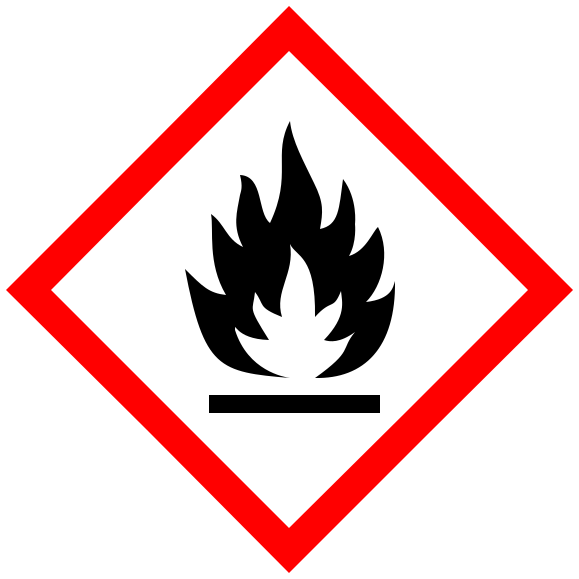

Danger
Acetylene
- Extremely flammable gas.
- Keep away from heat, hot surfaces, sparks, open flames and other ignition sources. No smoking.
- Keep container tightly closed.
- Store in a well-ventilated place.
Supplier name, address and telephone number· Product identifier·Nominal quantity
Need this as an actual label? Open Acetylene in the GHS label constructor →
07 · Health hazards
Acetylene health hazards and exposure limits
Acetylene hazard summary
Acetylene is an explosive hazard and simple asphyxiant. [LaDou, p. 558] Possible frostbite from contact with liquid; [NIOSH] Acetylene is in the list of Some volatile substances which may be abused by inhalation published on the web site of the U.N. International Drug Control Programme, indicating its potential to cause narcosis in workers. [Reference #1]
Source: Haz-Map, Information on Hazardous Chemicals and Occupational Diseases
Acetylene occupational exposure limits
| Limit | Value | Source |
|---|---|---|
| PEL | none | The National Institute for Occupational Safety and Health (NIOSH) |
| REL | C 2500 ppm (2662 mg/m3) | The National Institute for Occupational Safety and Health (NIOSH) |
| IDLH | N.D. | The National Institute for Occupational Safety and Health (NIOSH) |
These are United States values. The European Union sets its own indicative and binding limits, and the figure that applies at a given workplace is the one in the local regulation — not the one shown here.
08 · Physical and chemical properties
Acetylene properties
Every value is shown with the conditions it was measured under and the source it came from. Where sources disagree, all values are listed rather than one being picked — the difference is usually a different form of the substance, not an error.
Acetylene boiling point
| Property | Value | Conditions | Source |
|---|---|---|---|
| Boiling point | -83.89 °C (-119 °F) | at 760 mmHg | CAMEO |
| -84 °C (-119.2 °F) | at 760 mmHg | DOE PAC | |
| -84.7 °C (-120.5 °F) | sublimes, sublimation point | HSDB |
Acetylene melting point
| Property | Value | Conditions | Source |
|---|---|---|---|
| Melting point | -80.7 °C (-113.3 °F) | triple point | HSDB |
| -80.7 °C (-113.3 °F) | DOE PAC | ||
| -83.89 °C (-119 °F) | sublimes | NIOSH |
Acetylene density
| Property | Value | Conditions | Source |
|---|---|---|---|
| Density | 0.377 g/cm³ | at 760 mmHg | HSDB |
| 0.909 g/cm³ | at 0 °C | DOE PAC | |
| 0.613 g/cm³ | at -80 °C | CAMEO |
Acetylene solubility
| Property | Value | Conditions | Source |
|---|---|---|---|
| Solubility | Soluble in water and many organic materials | HSDB | |
| Slightly soluble in ethanol, carbon disulfide; soluble in acetone, benzene, chloroform | HSDB | ||
| In water, 1200 mg/L at 25 °C | at 25 °C | HSDB |
Acetylene vapor pressure
| Property | Value | Conditions | Source |
|---|---|---|---|
| Vapor pressure | 33590 mmHg | NIOSH | |
| 33450 mmHg | at 20 °C | ICSC |
Acetylene flash point
| Property | Value | Conditions | Source |
|---|---|---|---|
| Flash point | -18.15 °C (-0.7 °F) | HSDB | |
| -17.78 °C (0 °F) | Haz-Map | ||
| NA (Gas) | NIOSH |
Acetylene autoignition temperature
| Property | Value | Conditions | Source |
|---|---|---|---|
| Autoignition temperature | 305 °C (581 °F) | HSDB |
Acetylene lower explosive limit (LEL)
| Property | Value | Conditions | Source |
|---|---|---|---|
| Lower explosive limit (LEL) | 2.5 % by volume | HSDB |
Acetylene upper explosive limit (UEL)
| Property | Value | Conditions | Source |
|---|---|---|---|
| Upper explosive limit (UEL) | 100 % by volume | HSDB | |
| 82 % by volume | HSDB |
Acetylene vapor density
| Property | Value | Conditions | Source |
|---|---|---|---|
| Vapor density | 0.91 (air = 1) | HSDB | |
| 0.907 (air = 1) | ICSC |
Acetylene odor threshold
| Property | Value | Conditions | Source |
|---|---|---|---|
| Odor threshold | Air: 620 ug/L; odor safety class B; B= 50-90% of distracted persons perceive warning of TLV. | HSDB | |
| detection: 240 mg/cu m; 1300-2750 mg/cu m | HSDB | ||
| The odor threshold for acetylene is 657.2 mg/cu m. | HSDB |
Acetylene critical temperature and pressure
| Property | Value | Conditions | Source |
|---|---|---|---|
| Critical temperature and pressure | 35.2 °C (95.4 °F) | HSDB |
Values compiled from PubChem Laboratory Chemical Safety Summary. Temperatures converted to Fahrenheit for reference.
09 · Fire and explosion
Acetylene fire and explosion behaviour
These are descriptions rather than measured values, so they are kept out of the table above and quoted here with the source that reported them.
Acetylene fire potential
Very dangerous fire hazard when exposed to heat or flame ...
Source: Hazardous Substances Data Bank (HSDB)
10 · Handling and storage
Acetylene storage and handling
Acetylene reactive group
CAMEO Chemicals places Acetylene in the reactive group Alkynes, with Acetylenic Hydrogen. Compatibility with other chemicals is worked out from the group, not from the individual substance — which is why two substances you have never seen react can still be flagged as a pair that must be separated.
A reactive group is a CAMEO Chemicals (US NOAA) grouping, not a GHS hazard class: it has no code, no category and no legal force. It is what the storage compatibility matrix on this site computes from.
Acetylene safe storage
Fireproof. See Chemical Dangers. Cool.
Source: ILO-WHO International Chemical Safety Cards (ICSCs)
Acetylene storage conditions
Keep container in a cool, well-ventilated area. Keep container tightly closed and sealed until ready for use. Avoid all possible sources of ignition (spark or flame). Segregate from oxidizing materials. Cylinders should be stored upright, with valve protection cap in place, and firmly secured to prevent falling or being knocked over. Cylinder temperatures should not exceed 52 degC (125 degF).
Source: Hazardous Substances Data Bank (HSDB)
Acetylene incompatible materials
Contact of acetylene with the concn /nitric/ acid in presence of mercury (II) salts forms trinitromethane, explosive above its mp, 15 °C. Subsequent addition of sulfuric acid produces tetranitromethane, a powerful oxidant of limited stability, in high yield.
Source: Hazardous Substances Data Bank (HSDB)
Planning storage for a mix of chemicals? Check Acetylene in the storage compatibility matrix →
11 · Transport
Acetylene UN number and transport classification
Transport classification is a separate system from the GHS classification above. It decides how a package is marked and how a load may be carried; it does not follow from the workplace label, and the workplace label does not follow from it. The entries below are linked by CAS number, never by name.
The same CAS number is shipped under more than one UN number. Which entry applies follows from the form and the concentration of the consignment — read the proper shipping name, not the CAS.
Acetylene under UN 1001 — shipping name, class and packing group
Europe · ADR 2025, Table A
| Proper shipping name (3.1.2) | Class | Classification code | PG | Labels (column 5) |
|---|---|---|---|---|
| ACETYLENE, DISSOLVED | 2 | 4F | — | |
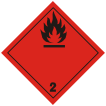
Source: ADR 2025, Table A of Chapter 3.2 · ECE/TRANS/352 Vol. I (UNECE). Class 2 is “Gases” (ADR 2.1.1.1).
United States · 49 CFR 172.101 Hazardous Materials Table
| Proper shipping name (column 2) | Class or division | PG | Labels (column 6) |
|---|---|---|---|
| Acetylene, dissolved | 2.1 | — | |

Source: 49 CFR 172.101 Hazardous Materials Table · eCFR, revision 2026-08-03. Class 2.1 is “Flammable gas” (49 CFR 173.2).
Acetylene under UN 3374 — shipping name, class and packing group
Europe · ADR 2025, Table A
| Proper shipping name (3.1.2) | Class | Classification code | PG | Labels (column 5) |
|---|---|---|---|---|
| ACETYLENE, SOLVENT FREE | 2 | 2F | — | |
Source: ADR 2025, Table A of Chapter 3.2 · ECE/TRANS/352 Vol. I (UNECE). Class 2 is “Gases” (ADR 2.1.1.1).
No entry for UN 3374 in the 49 CFR 172.101 table.
12 · Questions
Acetylene — frequently asked questions
What is the CAS number of Acetylene?
The CAS number of Acetylene is 74-86-2. Its EC number is 200-816-9.
What is the chemical formula of Acetylene?
The molecular formula of Acetylene is C2H2 and its molecular weight is 26.04 g/mol.
What does a Acetylene label have to show?
Under CLP Annex VI the label for Acetylene carries the pictograms Flame and Gas cylinder and the signal word is Danger.
Is Acetylene flammable?
Yes. CLP Annex VI assigns Acetylene H220 — extremely flammable gas. Its flash point is -18 °C (0 °F), a figure on which HSDB and Haz-Map agree.
Is Acetylene a carcinogen?
CLP Annex VI records no harmonised carcinogenicity classification for Acetylene. Annex VI is a list of agreed classifications, not a list of substances found safe, so this is an absence of a classification rather than a clean bill of health.
What is the exposure limit for Acetylene?
The US occupational exposure limit reported for Acetylene is none (The National Institute for Occupational Safety and Health (NIOSH)). Limits differ by country: the EU sets its own indicative and binding values, and the figure that applies at a given workplace is the one in the local regulation.
What is the boiling point of Acetylene?
The boiling point of Acetylene is -83.9 °C (-119 °F), a figure on which USCG via CAMEO and DOE PAC agree.
What is the melting point of Acetylene?
The melting point of Acetylene is -80.7 °C (-113 °F), a figure on which HSDB and DOE PAC agree.
How should Acetylene be stored?
CLP Annex VI assigns Acetylene the storage statement P403. Keep container in a cool, well-ventilated area. Keep container tightly closed and sealed until ready for use. Avoid all possible sources of ignition (spark or flame). Segregate from oxidizing materials. Cylinders should be stored upright, with valve protection cap in place, and firmly secured to prevent falling or being knocked over. Cylinder temperatures should not exceed 52 degC (125 degF). (Hazardous Substances Data Bank (HSDB))
Nearby
Substances next to Acetylene
Keep going: substances starting with A, or search the whole database by name, CAS number, pictogram or signal word.
Next